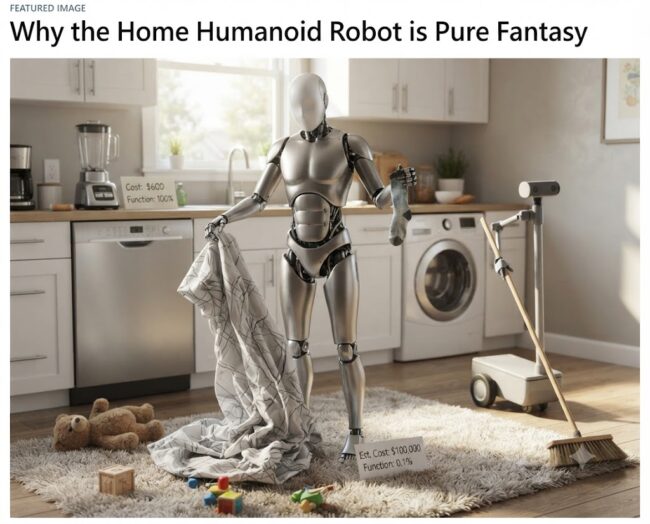
The $100,000 Chore Boy:
Step aside, crypto, Web3, and the metaverse. The venture capital engine has found its new favorite sandbox: the home humanoid robot.
Billions of dollars are currently being poured into tech start-ups and corporate vanity projects to ensure that a bipedal, titanium-alloy machine can eventually stand in your kitchen. Prominent tech moguls and breathless investment decks assure us that within the “foreseeable future,” a helpful, mechanical butler will wander our hallways, single-handedly fixing our household budgets by maximizing “labor efficiency”.
It is a beautiful, seductive vision. It is also an absolute, unadulterated fantasy.
The Economics of a $200,000 Dustpan
The central tenet of the humanoid hype machine is practicality: a robot will save you time and money. Let us subject this to some basic math.
The current average selling price for a full-scale, bipedal humanoid platform sits comfortably between $50,000 and $245,000. For the sake of charity, let’s assume mass manufacturing slashes that price tag down to a “reasonable” $40,000 in the coming years.
Now, look around your living room. What fiscal bleeding are we trying to stop with this investment?
- The Roomba Alternative: A high-end robot vacuum costs roughly $800. It doesn’t have a face, it cannot discuss philosophy, and it occasionally gets trapped under a armchair—but it vacuums. Replacing it with a $40,000 bipedal unit to hold a traditional broom is the financial equivalent of buying a commercial Boeing 747 to commute across town.
- The Laundry Conundrum: Tech keynotes love showing robots gently folding a single, perfectly flat t-shirt in a sterile lab environment. They rarely show what happens when that same robot faces an inside-out, static-cling-heavy fitted sheet or a stray sock wedged behind the dryer. Even if it succeeds after forty minutes of intense computational straining, the return on investment (ROI) for “automated folding” requires you to live for approximately three hundred years just to break even on the initial hardware costs.
The Architectural Nightmare of the Human Home
The industrial robotics market succeeds because factories are entirely redesigned around the machines. A car assembly line is a predictable, millimeter-perfect landscape.
Your home, by contrast, is a chaotic obstacle course of unpredictable variables.
[The Idealized Lab Envionment] ----> Perfect lighting, flat floors, predictable objects
                                              vs.
[The Average Household Reality] --> Scattered dog toys, shag rugs, variable stairs, human chaos
Humanoid hardware is incredibly fragile. A modern humanoid arm requires up to seven degrees of freedom, meaning seven independent, hyper-precise actuators per limb. They require zero-backlash motion and constant real-time feedback just to avoid punching a hole through your drywall.
When an industrial robot experiences an actuator failure on a factory floor, a team of specialized engineers shuts down the sector for maintenance. When your home humanoid experiences a joint sensor glitch while carrying a boiling pot of pasta across a slippery linoleum floor, you don’t get an efficiency gain—you get a homeowners insurance claim.
Imaginary Solutions to Real Non-Problems
The tech industry is currently spending billions solving a problem that was already solved decades ago by much simpler, cheaper, and vastly superior engineering.
We do not need a bipedal robot with a human face to wash our dishes; we call that a dishwasher. It costs $600, it sits under the counter, and it does not need to balance on two legs to clean a plate. We do not need a 200-pound humanoid to wash our clothes; we call that a washing machine.
               THE AUTOMATION HIERARCHY

   [ Highly Practical / Cost-Efficient ]
   └── Dishwashers, Roombas, Washing Machines

   [ Impractical / Infinite Venture Capital Sink ]
   └── Bipedal Humanoids Folding Socks at 0.2 mph
The insistence on the humanoid form factor for domestic chores is purely aesthetic. It is driven entirely by the desire to fulfill a 1960s science-fiction trope, rather than a clear-eyed assessment of household utility. An “arm on a stick” attached to a heavy, wheeled base is vastly safer, cheaper, and more stable than a top-heavy bipedal machine trying to navigate a flight of stairs while holding a laundry basket. But an arm on a stick doesn’t look cool in a promotional video, so the venture capital money flows elsewhere.
The Verdict
For the foreseeable future, the domestic humanoid robot will remain exactly what it is today: an incredibly expensive toy for tech billionaires, a brilliant marketing tool for industrial automation firms, and a bottomless pit for venture capital speculation.
The idea that these machines will become mainstream, budget-friendly household assets that save you money on daily tasks ignores the fundamental laws of physics, economics, and basic common sense. Until a robot can successfully navigate a messy children’s playroom, figure out how to untangle a bunch of charging cables, and do it all for less than the cost of a used sedan, keep your day job—and keep your vacuum cleaner.
About Brian French
Led by a commitment to tech-intelligent curation, Brian French tracks and analyzes breaking business news with Fl Business Newswire. Brian brings an extensive financial background to his analysis, having graduated from the University of South Florida in Finance and serving as a Vice President and Portfolio Manager for Merrill Lynch Private Investors and the Trust Department in St. Petersburg, FL, as well as a Vice President and Trust Investment Officer for SunTrust Bank in Sarasota, FL. His writing blends macroeconomic trends, capital market analysis, corporate strategy, and modern digital insights for a sophisticated look at Florida's business market.