FOR IMMEDIATE RELEASE
The Workforce Behind the Skyline: Why Apprenticeship Programs Will Decide South Florida’s Next Decade of Growth
Coconut Creek, FL — Every conversation about South Florida’s future eventually arrives at the same set of images: new towers rising over Biscayne Bay, corporate campuses landing in Broward, hospital systems expanding in Palm Beach County, and the infrastructure — roads, utilities, schools, transit — required to knit it all together. What those conversations too rarely include is the question underneath every rendering and groundbreaking: who, exactly, is going to build it?
The ABC Florida East Coast Chapter, which operates one of the region’s longest-standing construction education programs from its ABC Institute campus in Coconut Creek, believes that question — and the apprenticeship pipeline that answers it — has become the single most underappreciated variable in Southeast Florida’s growth story. The chapter’s registered apprenticeship and safety training programs serve the tri-county commercial construction industry, and its leadership argues that the region’s economic ambitions now rest as much on classroom nights in Coconut Creek as on the capital flowing into downtown Miami.
The argument deserves a full hearing, because the numbers behind it are not abstract.
Growth Written in Concrete
South Florida’s expansion over the past decade has been extraordinary by any national measure. The metropolitan corridor from Miami through Fort Lauderdale to West Palm Beach has absorbed waves of new residents, corporate relocations, and institutional investment, and the built environment has raced to keep up. Residential towers, logistics facilities serving the ports and airports, healthcare campuses, hospitality projects, and public infrastructure have kept the regional project pipeline full through economic conditions that slowed other markets.
But construction output has a governor on it that no amount of capital can override: the number of qualified people available to do the work. Concrete does not place itself. Electrical rooms do not wire themselves. Mechanical systems the size of small houses do not install, balance, and commission themselves. Every schedule promise made at a groundbreaking is ultimately a promise about labor — and Southeast Florida’s supply of skilled construction labor has been running behind its demand for years.
Statewide industry analyses have repeatedly flagged tens of thousands of unfilled construction positions across Florida, with the tri-county market among the most constrained. The consequences show up quietly but everywhere: extended project schedules, escalating labor costs that feed directly into housing prices and commercial rents, and contractors declining work they cannot staff. When a region’s growth ambitions exceed its workforce, the workforce becomes the growth plan.
The Retirement Wave No One Can Postpone
Compounding the shortage is a demographic reality the industry has seen coming for a generation: the skilled trades workforce is older than the labor force as a whole, and its most experienced members are leaving. Every retiring journey-level electrician, pipefitter, or mechanical technician takes with them decades of field judgment — the accumulated pattern recognition that tells a veteran which detail on the drawings will cause trouble, which shortcut is dangerous, and how to sequence a floor so four trades can work it without collision.
That knowledge does not live in textbooks, and it cannot be downloaded into a new hire during orientation. It transfers one way: experienced workers teaching newer ones, on real projects, over years. This is precisely the mechanism registered apprenticeship formalizes — and it is why the chapter frames apprenticeship not as one training option among several, but as the region’s knowledge-preservation system. A market that fails to run that system at scale does not merely face a headcount problem in 2030; it faces a competence problem, which is far more expensive.
How the Apprenticeship Engine Works
The registered apprenticeship model operating at the ABC Institute follows the structure that has produced skilled tradespeople in America for over a century, refined to Florida’s sponsorship framework.
Apprentices are employed full time by a sponsoring contractor from the start of the program, earning wages and benefits while they train. One to two evenings per week, they attend related technical instruction at the Institute. Their field development is documented through required annual on-the-job training hours logged with their employer, layered alongside the classroom hours, across a program that typically runs four years. Wage scales step upward as apprentices demonstrate progression, and graduates finish at journey-level standing — with a nationally recognized credential, years of verified project experience, and zero educational debt.
For applicants who arrive without an employer, the chapter assists qualifying candidates with placement among its member contractors — the same companies that shape the curriculum and hire its graduates. That closed loop between classroom and job site is the model’s quiet advantage: the training answers to the industry’s actual needs because the industry is in the room.
The chapter’s education catalog, anchored by these craft programs, extends across the career arc — from first safety credential to foreman certification and continuing education for working professionals. It is a structure built on a simple premise: South Florida does not just need more construction workers; it needs a system that turns beginners into experts and experts into leaders, continuously, for decades.
Safety Credentials: The Foundation Under the Foundation
Before any apprentice bends conduit or brazes a joint, the industry’s first requirement is safety literacy — and here too, formal training has shifted from advantage to expectation.
The OSHA Outreach program’s two tiers have become South Florida’s de facto standards. For workers entering the field, the 10-hour course delivers the essentials: recognition of the fall, struck-by, electrical, and caught-in/between hazards that cause the overwhelming share of construction casualties, along with the protective systems employers must provide and the rights workers hold under federal law. In a hiring environment this active, the credential functions as a fast-pass: candidates who complete osha 10 certification miami contractors look for arrive at the trailer door already speaking the site’s safety language, and hiring managers across Miami-Dade and Broward treat that card accordingly.
For the leadership tier — foremen, superintendents, safety coordinators — the 30-hour course carries proportionally greater weight, because supervision carries proportionally greater responsibility. The curriculum moves beyond personal safety into site governance: fall protection planning, excavation competent-person duties, scaffold oversight, hazard communication programs, and the inspection and documentation obligations that regulators and owners now scrutinize closely. Field leaders pursuing osha 30 training fort lauderdale projects increasingly require for supervisory roles are, in practical terms, acquiring the license to lead — and their employers are acquiring lower incident rates, stronger insurance positions, and better standing in the safety prequalifications that now gate access to major work.
The connection to the growth thesis is direct. A region building at South Florida’s pace multiplies its exposure to construction risk with every additional active site. Safety training at scale is what allows the boom to proceed without a proportional rise in human cost — and the markets that manage that balance are the ones where owners keep building.
Three Trades That Will Carry the Region
Within the apprenticeship catalog, three crafts illustrate how directly workforce development maps onto South Florida’s growth trajectory.
Electrical: Powering Density and Technology
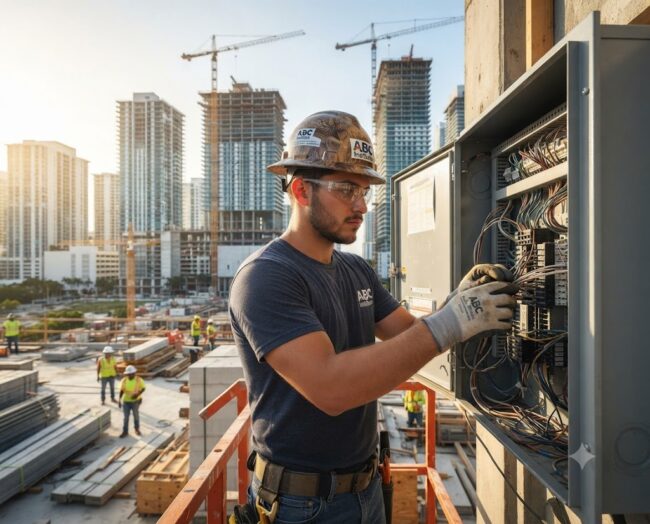
Everything the region is becoming — denser, taller, more technology-intensive — is electrically hungry. High-rise residential, healthcare facilities with life-safety power systems, data and logistics infrastructure, EV charging buildout, and the modernization of an aging grid all converge on the same constrained resource: qualified electrical workers. The chapter’s electrical program builds them from the ground up — code study, circuit theory, raceway installation, motor controls, grounding and bonding — with every principle exercised on live commercial projects under journey-level supervision. For a candidate weighing career paths, an electrician apprenticeship south florida sponsors underwrite offers a rare proposition: a four-year, fully paid education in the trade most fundamental to everything the region intends to build next.
Mechanical/HVAC: The Trade the Climate Makes Essential
In most of the country, air conditioning is a comfort system. In South Florida, it is life-safety infrastructure and building-preservation equipment in one — the system that makes every school, hospital, office, and warehouse occupiable year-round and holds humidity at bay in structures that would otherwise deteriorate. The commercial tier of the trade demands genuine technical depth: refrigeration cycles, chilled-water plants, building automation, ventilation design, and federal refrigerant-handling certification. Every building added to the skyline permanently expands the installed base requiring skilled installation, maintenance, and eventual replacement — which is why an hvac apprenticeship fort lauderdale member contractors sponsor represents one of the most structurally secure career investments available to a young worker in this market. The demand is not cyclical; it is climatological.
Plumbing: The Regulated Craft Beneath Every Floor
Plumbing rarely headlines a project rendering, but no certificate of occupancy issues without it — and in commercial work, it is among the most code-intensive crafts on site. Medical gas systems in the region’s expanding healthcare footprint, backflow prevention protecting public water, storm drainage engineered for tropical rainfall, and high-occupancy fixture systems all sit inside regulatory frameworks that take years to master. The chapter’s program transmits that mastery through the same earn-while-you-learn structure, and for candidates in the trade’s tightest local market, a plumbing apprenticeship broward county employers actively recruit from is a direct, debt-free route into a licensed-track profession that automation cannot touch and distance cannot outsource.
The Economic Case Families Should Hear
For South Florida households weighing post-secondary paths, the apprenticeship model presents an economic comparison that deserves honest attention. The conventional four-year route typically means four years of tuition costs and deferred earnings. The apprenticeship route inverts both terms: four years of full-time wages with scheduled raises, education delivered at night at no tuition burden to the student, and graduation into journey-level pay with a licensure runway ahead — toward supervision, project management, or eventually ownership of a contracting business. Neither path is superior for every person; but only one of them pays the student to become an expert, and in a region with South Florida’s cost of living, that difference compounds meaningfully over a young career.
There is also a civic dimension the chapter emphasizes: apprenticeship keeps opportunity local. The trades cannot be offshored, and the wages they generate are earned and spent inside the regional economy. A robust apprenticeship pipeline is, in effect, a mechanism for converting the region’s construction boom into durable middle-class careers for its own residents — the kind of economic mobility infrastructure that outlasts any single building cycle.
Leadership Development: Finishing the Pipeline
Craft skill alone does not complete a workforce. The industry’s other chronic shortage is field leadership — the foremen and superintendents who translate drawings and schedules into coordinated daily production while keeping crews safe. The chapter’s foreman certification and supervisory coursework exists to finish the pipeline: identifying strong tradespeople and equipping them with the planning, communication, and crew-management capabilities that leadership demands. Combined with supervision-level safety credentials, this track answers the question every growing contractor in the region is asking — where its next superintendents will come from — with a system rather than a hope.
For Employers: Training as Production Capacity
For member contractors, the chapter frames workforce development in operational terms. A company that routes helpers into apprenticeships, crews through safety courses, and rising leaders through certification is not spending on education; it is manufacturing the capacity to accept its next project. As owners and construction managers increasingly weigh documented training and safety records in prequalification, credentialed workforces also compete for work from a measurably stronger position. In a labor-constrained market, the contractors who train are the contractors who grow — and the chapter’s programs exist so that member firms of every size can run that strategy without building training infrastructure alone.
The Housing and Resilience Connection
Two of South Florida’s defining policy challenges — housing affordability and climate resilience — are usually discussed as questions of financing, zoning, and engineering. Both are also, unavoidably, workforce questions.
Labor scarcity is a direct input to housing cost. When skilled trades are in short supply, wages escalate, schedules stretch, and carrying costs rise — and every one of those pressures lands in the final price of a unit. A region that expands its skilled workforce is, in a very real sense, running a supply-side housing affordability strategy: more qualified crews mean more concurrent projects, shorter build cycles, and less scarcity premium embedded in every square foot delivered. No housing plan for Southeast Florida is complete without a labor plan underneath it.
Resilience tells the same story. The hardening work the region’s future demands — stronger building envelopes, elevated mechanical and electrical systems, upgraded drainage, storm-rated infrastructure — is precisely the work of the licensed trades. Every resilience dollar appropriated by a county commission ultimately has to pass through the hands of an electrician, a plumber, or a mechanical technician qualified to install it. Training that workforce is not adjacent to the region’s climate agenda; it is the delivery mechanism for it.
Widening the Pipeline
The chapter also emphasizes that the apprenticeship gateway is broader than tradition sometimes suggests. Career-changers leaving stagnant industries, veterans transitioning from military service with discipline and mechanical aptitude already in hand, recent graduates unconvinced by the debt-financed path, and workers already on job sites who want a formal credential behind their experience — all fit the model, because the model’s only real prerequisites are reliability and the willingness to learn. The paid structure removes the barrier that blocks most adult retraining: no one has to stop earning in order to start over. For a region whose growth depends on enlarging its skilled workforce rather than merely competing for the existing one, that accessibility is not a footnote. It is the point.
An Invitation to Build the Builders
The chapter is currently enrolling across its program catalog — OSHA safety courses, registered craft apprenticeships, foreman certification, and continuing education — and invites three audiences to engage: individuals ready to start a paid career in the trades, working construction professionals ready to formalize and advance their credentials, and employers ready to become sponsoring contractors and grow their own workforce.
South Florida’s next decade will be defined by what it builds — and what it builds will be defined by who it trains. The cranes are already up. The question the region answers next, one apprentice at a time, is who will be standing under them.
Safety training and industry resources are available at https://abceastflorida.com/industry-resources/. The complete education and apprenticeship catalog is available at https://abceastflorida.com/services/education/.
About ABC Florida East Coast Chapter
The ABC Florida East Coast Chapter is part of Associated Builders and Contractors, the national construction trade association founded on the merit shop philosophy — that construction work should be won on merit through open, fair competition regardless of labor affiliation. From its ABC Institute campus in Coconut Creek, the chapter delivers registered apprenticeship, safety, leadership, and continuing education programs to the commercial construction industry across Miami-Dade, Broward, and Palm Beach counties, while providing advocacy, networking, and business development services to member contractors throughout Southeast Florida.
Contact
ABC Florida East Coast Chapter Corporate Office 3730 Coconut Creek Pkwy, Suite 200 Coconut Creek, FL 33066 Phone: (954) 951-3911 Web: https://abceastflorida.com/
About Brian French
Led by a commitment to tech-intelligent curation, Brian French tracks and analyzes breaking business news with Fl Business Newswire. Brian brings an extensive financial background to his analysis, having graduated from the University of South Florida in Finance and serving as a Vice President and Portfolio Manager for Merrill Lynch Private Investors and the Trust Department in St. Petersburg, FL, as well as a Vice President and Trust Investment Officer for SunTrust Bank in Sarasota, FL. His writing blends macroeconomic trends, capital market analysis, corporate strategy, and modern digital insights for a sophisticated look at Florida's business market.