By Brian French | FlBusinessNewswire.com | October 16, 2026
Quick Answer
For Florida auto repair owners, the scarcest resource is no longer customers or parts. It is skilled labor. Owners are paying more to hire fewer qualified technicians, buying expensive equipment to service software-heavy vehicles, and turning away jobs they can’t staff. The shops that survive will treat technicians as their core asset and price their work to match.
What Owners Need to Know
- Demand is strong, but bay capacity, not customer count, now limits revenue.
- Each unfilled technician position quietly drains six figures in annual labor sales.
- Equipment for modern vehicles is a capital decision, not a supply purchase.
- Florida-specific costs, from storm-damaged cars to a $15 wage floor, hit shop margins directly.
- Owners who raise rates without improving service risk losing customers to chains and dealers.
A Business With Plenty of Demand and Not Enough Hands
Ask a Florida shop owner what keeps them up at night in 2026, and few will say “not enough cars.” The phones ring. The lot fills up. Demand is the easy part.
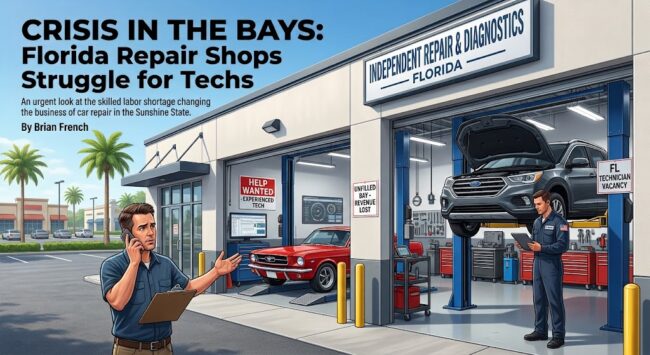
The hard part is getting the work done. An independent owner in Pinellas or Broward may have four lifts and only two technicians capable of diagnosing a late-model SUV. That means two lifts sit idle while customers wait, and the owner watches revenue he can’t capture drive off to a competitor.
This is the reality across Florida’s small business economy, but auto repair feels it more sharply than most trades. Small firms make up nearly the entire business base of the state, accounting for 99.8% of Florida companies according to the SBA. Many of those are owner-operated shops with a handful of employees, where losing one skilled worker changes the entire financial picture.
The Hiring Math Owners Are Up Against
Shop owners aren’t imagining the shortage. National data puts numbers on what they experience at the service counter.
TechForce Foundation’s 2026 workforce report estimates the U.S. needs nearly 71,000 new automotive technicians a year but will produce only about 50,000, a yearly deficit of more than 20,000. Applying Florida’s share of the national technician workforce to that figure, FloridaBusinessNewswire.com estimates the state falls behind by roughly 1,300 qualified techs every year.
For an owner, that gap shows up in three ways:
- Fewer applicants. Job postings for experienced A-level techs can sit open for months.
- Weaker applicants. Many candidates can handle brakes and fluids but not network diagnostics or calibrations.
- Poaching. Every competitor is fishing in the same small pond, so a trained tech can move for a modest raise.
The retention risk is real. Industry survey data from WrenchWay shows about one in five technicians expects to exit the trade within five years, citing pay, burnout or better options rather than retirement. An owner who loses one of those people loses years of training investment overnight.
Why Florida Pay Makes Recruiting Harder
Florida owners also compete on a tilted field. BLS data for 2024 placed the statewide median technician wage at $48,520, slightly under the national median of $49,670. Meanwhile, housing costs in Miami, Tampa Bay and Orlando have climbed well above what that wage comfortably supports.
| Owner Hiring Pressure | What It Means at the Shop |
|---|---|
| Below-national median pay | Harder to recruit from out of state |
| High metro housing costs | Techs leave for higher-paying trades |
| Tool ownership burden | Young techs start in debt |
| Rising wage floor | Helper and porter costs climb |
That last line matters more than many owners expect. Florida’s minimum wage stepped up to $15.00 an hour on September 30, 2026. Shops that rely on entry-level lube techs, porters and shop helpers are absorbing that increase now, and experienced techs reasonably expect their own pay to move up to maintain the gap.
The Hidden Cost of an Empty Bay
Most owners track what they spend. Fewer track what they lose. An empty bay is a loss that never shows up on an invoice.
Here is a simple illustration. These are hypothetical figures, not industry averages, meant to show the math an owner should run with their own numbers:
| Illustrative Bay Economics | Example Figure |
|---|---|
| Posted labor rate | $150/hour |
| Billed hours per tech per day | 6 |
| Working days per year | 250 |
| Annual labor sales per staffed bay | $225,000 |
FloridaBusinessNewswire.com illustration. Substitute your shop’s actual rate and productivity.
Under those assumptions, one unfilled technician seat costs a shop roughly $225,000 in labor sales a year, before counting the parts margin that rides along with each job. Seen this way, a $10,000 signing bonus or a paid tool allowance isn’t an expense. It’s a bargain.
The front counter leaks money too. OktoRocket’s benchmark of more than 1,000 independent shops found the typical location misses about one in ten incoming calls, which the company values at more than $16,000 in lost revenue per month for the median shop. Annualized, that is close to $200,000. Understaffed shops tend to miss more calls, not fewer, because the service writer is often also covering parts, payments and customer pickups.
Today’s Cars Demand a Different Kind of Shop
Owners who opened their doors 20 years ago built businesses around mechanical skill. That foundation still matters, but it is no longer enough.
Calibration Has Become Everyday Work
Driver-assistance systems used to be a luxury-car issue. Not anymore. Mitchell figures in Enlyte’s 2026 report show calibrations showed up on about a third of repair estimates in 2025, nearly triple the 2022 share, at an average of $688 each.
For an owner, that is both a threat and an opening. Jobs that once ended at bolting a part on now require aiming cameras and radar afterward. Shops that can’t do it in-house either sublet the work and lose margin, or lose the job entirely.
The Capital Decision
Bringing calibration in-house is not cheap. Industry reporting puts a dedicated calibration system around $28,000, plus roughly $12,000 for the computer to run it, before vehicle-specific targets and floor space.
A rough owner’s test: at an average ticket of $688, a $40,000 setup needs about 58 calibrations just to recover the equipment cost in gross revenue, not counting technician time, training, software updates or the space it occupies. A busy collision or glass shop can clear that in months. A small general repair shop may take years.
| Calibration Option | Owner Upside | Owner Risk |
|---|---|---|
| Buy equipment in-house | Keep margin and control timing | Heavy capital, needs trained tech |
| Sublet to mobile service | No capital outlay | Lower margin, scheduling delays |
| Refer job out | Zero risk | Customer may not come back |
Software Is the New Toll Booth
Owners also pay to access the cars they fix. Modern repairs often require an automaker’s diagnostic software and an active subscription. In some cases, even resetting an oil-life monitor carries a software charge that shops pass on as $50 to $75. Multiply those subscriptions across a dozen brands and the annual software bill becomes a line item owners didn’t budget for a decade ago.
Florida’s Electric Fleet Is Arriving
Florida owners can’t ignore electrification for long. The state registered more than 250,000 new EVs in 2025, about 10.5% of new registrations and second only to California nationally. Those vehicles will leave warranty and look for independent service. Owners who build high-voltage capability early will have that market largely to themselves for a while.
Florida Conditions Owners Can’t Control
Every state has a technician shortage. Florida owners deal with several pressures on top of it.
Storm-Damaged Inventory
After major hurricanes, Florida shops inherit a wave of flood-exposed vehicles. CARFAX estimated Milton alone damaged up to 120,000 vehicles in Florida. Owners know what follows: months of intermittent electrical faults, corroded connectors and modules that fail without warning. These jobs eat diagnostic hours, are difficult to estimate accurately and often leave customers frustrated with the shop rather than the storm.
Many experienced owners now screen these vehicles at check-in, require a paid diagnostic up front and explain clearly that flood-related failures may recur.
Older Cars, More Repairs
The national fleet keeps aging. S&P Global Mobility reports the average U.S. vehicle is now 12.8 years old. For owners, this is good for demand, since older vehicles need more service. But it also means more seized bolts, rusted lines and repeat failures that slow down bay turnover.
The Compliance Clock
Florida’s Motor Vehicle Repair Act is clear and consumer-friendly. Shops must be registered with FDACS, offer a written estimate on jobs over $100, and secure customer approval if the bill will exceed the estimate beyond modest limits.
Good owners support these rules because they build trust. The operational reality, though, is that diagnostic-heavy jobs often change scope mid-repair. Every change requires reaching the customer, documenting approval and waiting. A car can sit on a lift for half a day while the service writer chases a callback. Owners who adopt text-based approvals and digital inspection reports with photos tend to cut that dead time significantly.
Pricing: Raising Rates Without Losing Customers
Owners are raising prices. The data confirms it. OktoRocket found effective labor rates at independent shops climbed as much as 6.2% in 2025, while parts costs stayed relatively flat. The longer trend is steeper: Federal Reserve data shows auto repair prices up 60% from early 2019 through August 2026, about double the overall inflation rate.
Customers notice. The challenge for an owner is raising rates in a way that customers accept.
Owners who manage this well tend to:
- Charge for diagnosis openly. Treat diagnostic time as a billable professional service, not a free courtesy.
- Show the work. Use photos and video in digital inspections so customers see what the technician saw.
- Explain the technology. A customer who understands that a bumper repair requires sensor recalibration is less likely to feel overcharged.
- Tier their pricing. Separate rates for general maintenance, advanced diagnostics and EV work reflect the real skill difference.
- Protect the relationship. Return calls, honor warranties and follow up after the repair.
Raising the rate is easy. Earning it every visit is what keeps the customer from trying the chain down the road.
Independent Owners vs. Chain Operators
Florida’s repair market splits into independents, regional and national chains, and dealerships. Owners in each group are solving different versions of the same problem.
Independent owners carry their reputation personally. Their advantage is loyalty and flexibility. They can pay a top tech above market, adjust hours or specialize quickly. Their disadvantage is scale. A $40,000 equipment purchase or a $200,000 missed-call problem lands on one balance sheet.
Chain operators spread equipment, training and marketing costs across many locations. Their pain point is turnover. High-volume maintenance work depends on entry-level labor, exactly where the new wage floor hits hardest, and standardized pay plans can make it harder to hold onto standout technicians.
Dealerships have the deepest factory access and training but face their own capacity crunch, which is why their service calendars often run weeks out. Their overflow is a real opportunity for well-equipped independents.
Succession: The Quiet Risk for Florida Shop Owners
Many Florida independents are run by owners in their 50s and 60s who built their shops over decades. The technician shortage creates a second problem for them: who takes over?
A shop’s value increasingly depends on its staff and its equipment, not just its building and customer list. A buyer, whether a younger technician, a regional operator or a private equity-backed group, will look hard at whether the skilled people will stay after the sale. Owners who plan to sell in the next five to ten years should be developing a lead technician or shop foreman now. A shop that depends entirely on the owner’s own diagnostic skill is worth far less to a buyer.
An Owner’s Action Plan for 2027
Shop owners don’t control the national pipeline, but they do control their own operations. Practical steps include:
- Build a training pipeline. Partner with a nearby technical college or high school automotive program and offer paid apprenticeships.
- Remove the tool barrier. Provide shop-owned scan tools and a tool allowance for new hires.
- Pay for growth. Tie raises to certifications so techs see a clear path to higher pay.
- Choose a lane. Decide whether to invest in calibration and EV service, or partner for them, rather than drifting into both halfway.
- Fix the front office. Answer every call, automate approvals and send digital inspections.
- Price for the skill. Set labor and diagnostic rates that reflect what modern repair actually requires.
- Plan succession early. Develop leaders inside the shop, not just technicians.
Brian’s Take
I spent years evaluating businesses as an investment manager, and auto repair in Florida checks a box I always looked for: demand that isn’t going away. People need their cars. The fleet is aging, the population is growing and vehicles are getting harder to fix. That is a durable market.
The constraint is labor, and constrained businesses reward the operators who solve the constraint. In practical terms, the Florida shop owner who treats recruiting and retaining technicians as the number-one job will out-earn the owner who treats it as a nuisance. A great technician is the highest-return asset in the building. Paying them well, training them and giving them good equipment isn’t overhead. It is the investment that unlocks every idle lift.
I also expect consolidation. Owners who run clean books, keep strong staff and invest wisely in technology will be acquisition targets at attractive values. Owners who don’t adapt will find their late-model customers drifting away, one declined job at a time.
Frequently Asked Questions
What is the biggest challenge for auto repair shop owners in Florida?
Finding and keeping qualified technicians. Customer demand is strong, but most shops can’t staff every bay with technicians able to handle modern diagnostics, calibration and EV work.
How much revenue does an unfilled technician position cost a shop?
It depends on the shop’s labor rate and productivity. Using an illustrative $150 hourly rate and six billed hours a day, one empty position can mean roughly $225,000 a year in lost labor sales, plus associated parts profit.
Should a small shop buy ADAS calibration equipment?
Only if volume supports it. A full setup can cost around $40,000, which takes dozens of calibrations to recover. Lower-volume shops often do better partnering with a mobile calibration service.
How are Florida shop owners handling rising labor costs?
Most are raising labor rates, charging openly for diagnostic time, and using digital inspections to show customers why the work is needed. Labor rates at independent shops rose as much as 6.2% in 2025.
Does Florida’s $15 minimum wage affect repair shops?
Yes. It raises pay for entry-level roles like lube technicians, porters and helpers, and puts upward pressure on experienced technician wages to keep pay differences meaningful.
What do Florida shop owners need to follow on estimates?
Shops must register with FDACS, offer a written estimate for repairs over $100, and get customer approval before exceeding the estimate beyond the limits set in the Florida Motor Vehicle Repair Act.
Is now a good time to sell a Florida auto repair shop?
For well-run shops with stable, skilled staff and modern equipment, buyer interest is strong. Shops that depend on one person’s skills or lack late-model capability may face lower valuations.
Sources and Further Reading
- TechForce Foundation, “Supply, Demand & Opportunity: 2026 Technician Workforce Report,” as reported by Tire Review
- U.S. Bureau of Labor Statistics, Occupational Employment and Wage Statistics, Automotive Service Technicians and Mechanics, Florida, May 2024, via WageDex
- U.S. Bureau of Labor Statistics, Occupational Employment and Wage Statistics, May 2025, and Employment Projections 2024–2034
- U.S. Small Business Administration Office of Advocacy, “2025 Small Business Profile: Florida”
- BoostSuite, “Florida Small Business Statistics: 2026 Data & Facts”
- WrenchWay 2026 Technician Stats, via Wicked File, “How to Recruit and Retain Qualified Auto Technicians in 2026”
- OktoRocket independent repair shop benchmark report, Business Wire, July 2026
- Enlyte, “2026 Envision Trends” report with Mitchell data, via Collision Repair Magazine
- AutoGuide, “Car Repair Costs Have Surged 60 Percent Since 2019,” citing Federal Reserve Bank of St. Louis data
- GadgetReview, “Car Repair Costs Have Climbed Twice as Fast as Inflation,” citing CNBC reporting
- Sarasota Magazine, “Florida Is One of the Biggest Electric Vehicle Markets in the United States,” April 2026
- CARFAX flood-damage estimates following Hurricane Milton, via Carrier Management
- S&P Global Mobility, “Average Age of Vehicles in the US Rises to 12.8 Years in 2025”
- Florida Department of Agriculture and Consumer Services, “Motor Vehicle Repair: Estimate and Invoice Requirements”
- Florida Office of the Attorney General, “How to Protect Yourself: Auto Repair Fraud”
About Brian French
Led by a commitment to tech-intelligent curation, Brian French tracks and analyzes breaking business news with Fl Business Newswire. Brian brings an extensive financial background to his analysis, having graduated from the University of South Florida in Finance and serving as a Vice President and Portfolio Manager for Merrill Lynch Private Investors and the Trust Department in St. Petersburg, FL, as well as a Vice President and Trust Investment Officer for SunTrust Bank in Sarasota, FL. His writing blends macroeconomic trends, capital market analysis, corporate strategy, and modern digital insights for a sophisticated look at Florida's business market.