By Brian French | Florida Authority Network | September 29, 2026
Quick Answer
Florida’s Space Coast is launching fewer rockets in 2026 than in its record 2025, but that slowdown is misleading. Billions are going into new launch pads, rocket factories and defense manufacturing from Brevard County to Tampa Bay. For Florida suppliers, the build-out phase happening now is the biggest opportunity, well before the next launch surge arrives.
The Twist: Fewer Launches, More Construction
On the surface, 2026 looks like a step back for the Space Coast. The region hosted a record 109 orbital launches in 2025, but by early September 2026, 55 rockets had launched from Florida. From May through August, the Cape averaged just six launches a month.
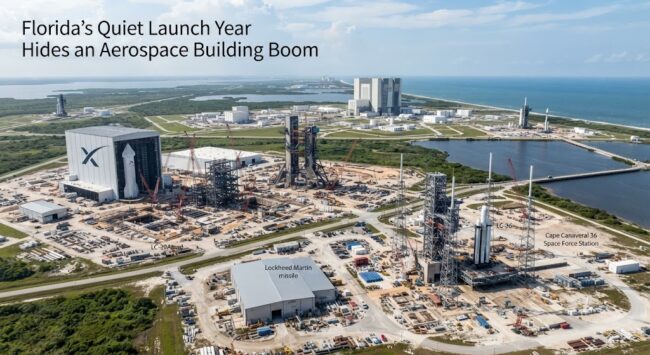
That’s the headline. The real story is underneath it. The slowdown reflects an industry retooling for a much bigger next phase: new heavy-lift pads under construction, a rocket factory rising at Kennedy Space Center, a major launch site being rebuilt after an explosion, and new defense manufacturing plants coming online.
For a Florida machine shop, electrical contractor, crane operator or engineering firm, a year of construction is often worth more than a year of launches. Launches are the product. Infrastructure is the purchase order.
The FAN Launch Capacity Gap
To show the scale of what’s coming, FAN compared Florida’s actual launch activity against the launch capacity already approved or planned.
| Measure | Launches/year |
|---|---|
| 2025 record (all rockets) | 109 |
| 2026 pace (FAN estimate) | ~80 |
| 2026 plan at start of year | up to 120 |
| Approved Starship capacity, Florida | ~120 |
2026 pace is a FAN annualization of 55 launches through early September. Starship capacity combines 44 approved launches at LC-39A and about 76 projected at SLC-37.
What it means: Approved capacity for Starship alone roughly matches Florida’s entire 2026 launch plan, and exceeds its all-time record. When those pads come online, Florida’s launch ceiling moves dramatically higher. The infrastructure to support that capacity is being built right now.
Why 2026 Slowed Down
Three factors explain the dip.
1. Blue Origin’s setback. On May 28, 2026, Blue Origin’s New Glenn rocket exploded during a hot-fire test at Launch Complex 36 at Cape Canaveral, destroying the booster and upper stage and toppling one of the pad’s two towers. LC-36 is New Glenn’s only launch pad, so the damage grounded the rocket. Blue Origin later traced the failure to the main oxygen valve on one of its BE-4 engines and says it intends to return to flight before the end of 2026.
2. SpaceX’s transition. SpaceX moved Falcon 9 launches off Kennedy’s LC-39A in December 2025, dedicating the historic pad to Falcon Heavy while building Starship infrastructure there.
3. Industry retooling. Starship test flights paused as SpaceX transitioned to the Block 3 version of the vehicle, while construction continued in Texas and Florida.
None of these signal decline. Each one is a company investing in larger vehicles and larger facilities in Florida.
The Milestone: Artemis II Returns Humans to the Moon
2026’s defining achievement launched from Florida. Artemis II lifted off April 1, 2026, from Launch Complex 39B at Kennedy Space Center, carrying NASA astronauts Reid Wiseman, Victor Glover and Christina Koch and Canadian astronaut Jeremy Hansen. They were the first people to head toward the moon since Apollo 17 in 1972.
The mission set a record. The crew reached 252,756 miles from Earth, surpassing Apollo 13’s 1970 distance record, before splashing down on April 10.
Florida’s role didn’t end at liftoff. Within weeks, teams moved the core stage for Artemis III into Kennedy’s Vehicle Assembly Building, while the Artemis II capsule returned to Kennedy for post-flight analysis. The next lunar mission is already being assembled on the Space Coast.
Starship Comes to Florida
The largest single infrastructure project on the Space Coast is SpaceX’s Starship expansion.
Launch pads: The U.S. Air Force approved SpaceX to develop Space Launch Complex 37 at Cape Canaveral Space Force Station for Starship. SpaceX plans three Florida launch pads in total: one at LC-39A and two at SLC-37.
Launch approvals: The FAA approved up to 44 Starship launches and 88 landings per year from LC-39A in February 2026, following a 16-month environmental review. SLC-37’s two pads are projected to support about 76 launches per year.
Factory: SpaceX is building a 380-foot-tall Gigabay at its Roberts Road complex with 815,000 square feet of workspace for Starship production and integration. Florida’s Gigabay has advanced faster than its counterpart at Starbase in Texas.
Timing: Starship operations from LC-39A are targeted for no earlier than late 2026.
Why suppliers should care: A facility of that size requires steel fabricators, electrical and mechanical contractors, concrete and foundation specialists, cranes and rigging, industrial gases, security and facilities services, and eventually a permanent maintenance workforce. Much of that spending happens before the first Florida Starship ever flies.
Blue Origin: Rebuilding and Expanding
Blue Origin’s explosion hurt, but the company’s Florida commitment is growing.
In June 2026, Blue Origin announced it would modify Launch Complex 36 rather than rebuild it in its previous configuration. The company also plans a new LC-36B pad, larger than the rebuilt LC-36A, to support a bigger 9×4 version of New Glenn.
Separately, the state reported in May 2026 that a new Blue Origin facility will support 500 aerospace jobs with an average salary above $98,000.
The stakes extend beyond Blue Origin’s own schedule. New Glenn is the launch vehicle for Blue Moon, one of two private landers NASA selected to put astronauts on the moon under Artemis. Customers are waiting too: Amazon Leo satellites were scheduled to fly on New Glenn in June before the explosion.
Defense Manufacturing on the Space Coast
The Space Coast isn’t only about launches. Defense manufacturing is a quieter but steadier engine.
Lockheed Martin is building an approximately 225,000-square-foot facility in Titusville to produce components for the Trident II D5LE2 submarine-launched ballistic missile. The $140 million plant is projected to bring up to 300 jobs at an average annual wage of $89,000, plus up to 100 naval personnel.
That fits a larger pattern. Florida ranks second in the nation for manufacturing aerospace and aviation products and parts, and second for manufacturing space and defense systems, according to the state’s economic development office.
Tampa Bay: The Defense Innovation Hub
Across the I-4 Corridor, Tampa Bay’s defense economy runs on a different model: less hardware manufacturing, more command, cyber, software and special operations technology.
The anchor: MacDill Air Force Base is the only military installation hosting two four-star combatant commands, U.S. Central Command and U.S. Special Operations Command. The Tampa Bay Defense Alliance puts MacDill’s direct economic impact at $3.9 billion, rising to $5 billion including military retirees within about 50 miles.
The ecosystem: The Tampa Bay region hosts more than 2,300 defense contractors supporting the two commands, and SOCOM’s annual procurement budget alone exceeds $3 billion, according to one defense consulting firm’s analysis. Tampa Bay EDC estimates the regional defense and security industry generates about $20 billion in total economic impact.
The innovation pipeline: SOFWERX, SOCOM’s innovation partner in Tampa, lowers barriers for nontraditional companies to work with the command. It has now facilitated more than $500 million in contracts, more than quadrupling its activity over three years.
New startups: Tampa Bay Wave secured a $1.38 million federal grant to launch a defense technology accelerator. The 18-month pilot will put 30 early-stage companies through two cohorts, with SOFWERX providing the technical programming.
Manufacturing still matters: Tampa Brass & Aluminum is investing $58 million in new machinery at its Hillsborough County headquarters, adding 50 jobs. The 69-year-old manufacturer has received more than $20.8 million in direct federal contracts, mostly through the Defense Logistics Agency.
Relocations: Defense firms are moving to be close to SOCOM. Orion Edge, an electronic warfare contractor, relocated its headquarters from Colorado to Tampa in October 2025 in a $20 million investment.
The Bottleneck: Cleared Talent
The biggest constraint on Florida’s defense and aerospace growth isn’t money or land. It’s people with the right clearances and skills.
A staffing firm’s analysis of Tampa’s defense cyber market reported that SOCOM’s fiscal 2026 modernization budget allocated $2.1 billion to command, control and communications upgrades, but warned that cyber positions requiring new clearance holders can sit empty for over a year before a candidate starts. Treat that as one firm’s view, but it matches what employers across the region describe.
Tampa’s regional advantage is its veteran base. The region has a veteran workforce of more than 80,000, many with clearances and specialized military experience.
On the Space Coast, the labor challenge is different: skilled trades and technicians for construction, fabrication and launch operations. As Starship and New Glenn infrastructure advance, competition for welders, electricians, pipefitters and test technicians will intensify.
Where Florida Suppliers Fit
The supply chain supporting Florida’s aerospace and defense economy reaches far beyond the prime contractors. Opportunities by category:
- Construction and infrastructure: Foundation work, steel erection, heavy lifting, tank farms, industrial electrical and fire protection for launch pads and factories.
- Precision manufacturing: CNC machining, casting, welding, composites and specialized fabrication for defense and launch hardware.
- Engineering services: Structural, mechanical, test and quality engineering, often on subcontract to primes.
- Secure facilities: SCIF construction, secure IT networks and cybersecurity services for defense contractors, especially in Tampa.
- Logistics: Heavy-haul transport, barge coordination, warehousing and just-in-time delivery for large components.
- Workforce services: Technical training, clearance-ready staffing, relocation services and housing for incoming engineers.
How to get in: Start as a subcontractor to a prime or a tier-one supplier. Register in federal procurement systems, pursue required certifications (such as quality management and cybersecurity compliance), and use regional connectors like SOFWERX, Tampa Bay Wave and the Space Coast EDC to meet buyers.
The I-4 Defense Corridor
Florida’s aerospace and defense economy is increasingly one connected corridor. Tampa Bay supplies command, special operations, cyber and software. Orlando, home to major Lockheed Martin missile defense and simulation operations, sits in the middle. The Space Coast supplies launch, spacecraft and strategic missile manufacturing.
That geography gives Florida an advantage few states can match: a company can build hardware in Brevard, test software with SOCOM partners in Tampa, and recruit engineers from universities along the entire corridor, all within a two-hour drive.
Brian’s Take
Early in my money-management career, I learned that the best time to look at an industry is during its capital-spending phase, not its peak-output phase. Output gets the headlines. Capital spending pays the suppliers.
Florida’s launch count is down in 2026, and some coverage has framed that as a slowdown. I see it differently. SpaceX is building pads for up to 120 Starship launches a year and a rocket factory with more than 800,000 square feet of space. Blue Origin is rebuilding and expanding. Lockheed is finishing a missile plant in Titusville. Tampa’s defense innovation pipeline has quadrupled. That’s not a slowdown. That’s the foundation for Florida’s next decade in aerospace.
The number I’ll be watching is simple: the first Starship launch from Florida. When it happens, the Space Coast shifts from building capacity to using it, and the demand for local services, housing, hospitality and skilled labor steps up again. Florida businesses that position themselves in the supply chain now will be ahead of that curve instead of chasing it.
Frequently Asked Questions
How many rockets launched from Florida in 2025?
A record 109 orbital launches, breaking the previous record of 93 set in 2024.
Why are fewer rockets launching from Florida in 2026?
Blue Origin’s New Glenn exploded during a May 2026 test, grounding it, and SpaceX has been shifting infrastructure toward Starship. Florida had 55 launches through early September 2026.
When will Starship launch from Florida?
SpaceX’s first Florida Starship launch from LC-39A is targeted for no earlier than late 2026.
How many Starship launches are approved in Florida?
The FAA approved up to 44 per year from LC-39A, and SLC-37 is projected to support about 76 per year, for roughly 120 combined.
When did Artemis II launch?
April 1, 2026, from Kennedy Space Center. The crew flew around the moon and splashed down April 10.
What is MacDill Air Force Base’s economic impact?
About $3.9 billion directly, rising to roughly $5 billion including military retirees in the region.
What is SOFWERX?
A Tampa-based nonprofit innovation partner of U.S. Special Operations Command that helps nontraditional companies work with SOCOM. It has facilitated more than $500 million in contracts.
How can small Florida businesses enter the aerospace supply chain?
Typically by subcontracting to prime contractors or tier-one suppliers in construction, precision manufacturing, engineering, secure facilities or logistics, after registering for federal procurement and obtaining required certifications.
Sources and Further Reading
- Florida Today via Yahoo, “Florida rocket launches have slowed, but there’s 1 launch this weekend”: https://tech.yahoo.com/science/articles/florida-rocket-launches-slowed-theres-161956780.html
- Florida’s Space Coast Office of Tourism via PR Newswire, “Blasting Off Into 2026”: https://www.morningstar.com/news/pr-newswire/20260108fl57313/blasting-off-into-2026-floridas-space-coast-entices-travelers-with-record-launches-global-innovation-and-humanitys-planned-return-to-the-moons-orbit
- NASA, “Artemis II Mission Milestones: An Image and Video Recap”: https://www.nasa.gov/centers-and-facilities/johnson/artemis-ii-mission-milestones-an-image-and-video-recap/
- NASA, “NASA’s Artemis III Moon Rocket Hardware Arrives, Artemis II Capsule Returns to Kennedy”: https://www.nasa.gov/blogs/missions/2026/04/28/nasas-artemis-iii-moon-rocket-hardware-arrives-artemis-ii-capsule-returns-to-kennedy/
- NASASpaceFlight.com, “Blue Origin’s New Glenn explodes during Static Fire test at LC-36”: https://www.nasaspaceflight.com/2026/05/blue-origin-new-glenn-explodes/
- Space.com, “Blue Origin’s New Glenn rocket explodes in massive fireball during prelaunch test”: https://www.space.com/space-exploration/launches-spacecraft/blue-origins-new-glenn-rocket-explodes-in-massive-fireball-during-prelaunch-test
- IBTimes UK, “Jeff Bezos’ $30B Blue Origin Bet Is Now Worth $140B”: https://www.ibtimes.co.uk/jeff-bezos-blue-origin-outside-investors-spacex-1821967
- NASASpaceFlight.com, “Florida Starship progress with launch sites at KSC and Cape”: https://nasaspaceflight.com/2026/01/florida-starship-progress-ksc-cape/
- NASASpaceFlight.com, “SpaceX laying the Starship foundations for 2026 and beyond”: https://www.nasaspaceflight.com/2026/01/starship-foundations-2026/
- Space.com, “SpaceX can launch its Starship megarocket from Florida pad, Air Force says”: https://www.space.com/space-exploration/launches-spacecraft/spacex-can-launch-its-starship-megarocket-from-florida-pad-air-force-says
- Basenor, “Starship at the Cape: 6 Details That Matter”: https://www.basenor.com/blogs/news/starship-at-the-cape-6-details-that-matter
- Wikipedia, “Kennedy Space Center Launch Complex 39A”: https://en.wikipedia.org/wiki/Kennedy_Space_Center_Launch_Complex_39A
- Wikipedia, “Cape Canaveral Launch Complex 36”: https://en.wikipedia.org/wiki/Cape_Canaveral_Launch_Complex_36
- Economic Development Commission of Florida’s Space Coast, “EDC Announces Strategic Expansion of Lockheed Martin on Florida’s Space Coast”: https://spacecoastedc.org/edc-announces-strategic-expansion-of-lockheed-martin-on-floridas-space-coast/
- Powering Florida, Aviation & Aerospace: https://www.poweringflorida.com/explore-industries/aviation-aerospace.html
- Tampa Bay Defense Alliance, MacDill Air Force Base: https://tampabaydefensealliance.net/resources/macdill-air-force-base/
- Tampa Bay EDC, Defense & Security: https://tampabayedc.com/target-industries-tampa/defense-security/
- US Defense Group, “The Florida I-4 Corridor: Where Special Operations Meets the Space Coast”: https://www.us-dg.com/articles/florida-i4-defense-corridor
- FedGov Today, “How SOFWERX Became SOCOM’s Fast Lane for Defense Innovation”: https://fedgovtoday.com/guests/how-sofwerx-became-socoms-fast-lane-for-defense-innovation
- Tampa Bay Business & Wealth, “Tampa Bay Wave Gets $1.38M for Defense Startups”: https://tbbwmag.com/2026/08/26/tampa-bay-wave-defense-startups/
- Hoodline, “Tampa Brass & Aluminum’s $58M Hillsborough County Expansion”: https://hoodline.com/2026/09/tampa-manufacturer-bets-58m-on-town-n-country-over-texas-adds-50-jobs/
- KI Talent, “Tampa’s Defense Cybersecurity Sector Has Record Budgets and Record Vacancies”: https://kitalent.com/articles/tampa-defense-cybersecurity-hiring
About Brian French
Led by a commitment to tech-intelligent curation, Brian French tracks and analyzes breaking business news with Fl Business Newswire. Brian brings an extensive financial background to his analysis, having graduated from the University of South Florida in Finance and serving as a Vice President and Portfolio Manager for Merrill Lynch Private Investors and the Trust Department in St. Petersburg, FL, as well as a Vice President and Trust Investment Officer for SunTrust Bank in Sarasota, FL. His writing blends macroeconomic trends, capital market analysis, corporate strategy, and modern digital insights for a sophisticated look at Florida's business market.