By Brian French
March 31, 2026
Sources: U.S. Bureau of Economic Analysis, Federal Reserve Bank of St. Louis (FRED), Florida TaxWatch, UCF Institute for Economic Forecasting, Florida Chamber Foundation, Florida Legislature Office of Economic and Demographic Research
Welcome to the Big Leagues
There is a perception problem in Florida business circles that quietly costs companies real money. Too many businesses operating in this state — whether they were founded here, relocated here, or are expanding here — still think of Florida as a regional market. A warm-weather destination economy. A place where retirees spend and tourists visit and everyone goes home happy.
That mental model is dangerously out of date.
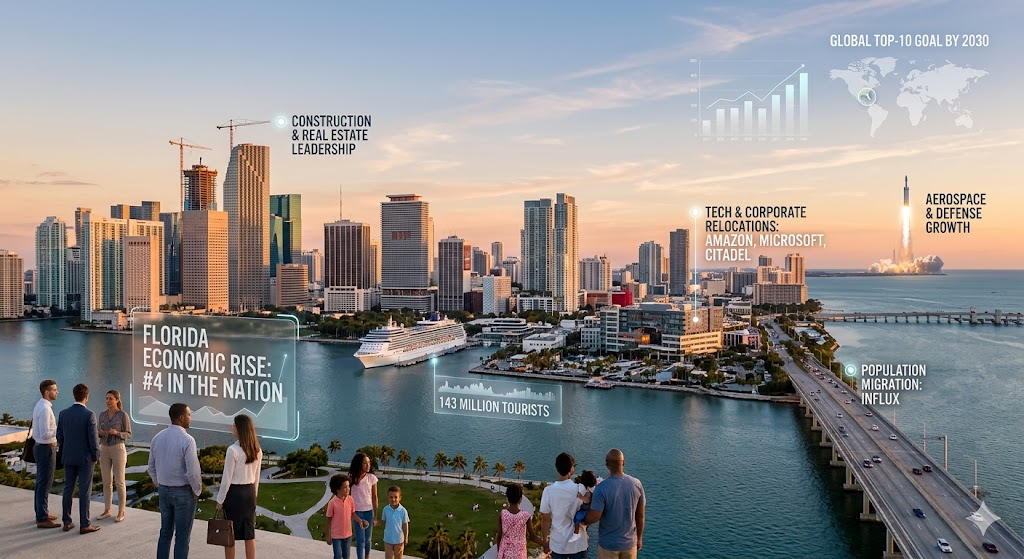
Florida is now the fourth-largest economy in the United States and the fifteenth-largest on the planet. The businesses serving this market — from professional services and logistics to construction, finance, and technology — are operating inside one of the most dynamic economic environments in the world. The companies that recognize this are positioning and investing accordingly. The ones that don’t are leaving opportunity on the table, or worse, being outcompeted by firms from New York, California, and Europe that have already figured out what Florida actually is.
So let’s settle the question with data.
What the Numbers Actually Show
Florida’s economy is the fourth-largest in the United States, with a $1.726 trillion gross state product (GSP) as of 2024. If Florida were a sovereign nation, it would rank as the world’s 15th-largest economy by nominal GDP, ahead of Spain and behind South Korea.
Florida is responsible for 5.82% of the United States’ approximately $28 trillion gross domestic product. That is not a regional economy. That is a force.
Florida’s real (inflation-adjusted) GDP reached approximately $1.3 trillion in 2024 — up 3.6% from 2023 and the highest on record. The real estate, rental, and leasing industry contributed the most to Florida’s GDP at $265.5 billion, followed by professional and business services at $208.3 billion and educational services, health care, and social assistance at $126.2 billion.
The three states ahead of Florida are California ($4.103 trillion), Texas ($2.709 trillion), and New York ($2.297 trillion). The gap between Florida and New York — currently about $570 billion — is closing. That is the number every serious Florida business leader should have on their radar.
Twenty Years of Growth: How Florida Got Here
Florida’s transformation did not happen overnight, and it was not inevitable. In the early 2000s, the state’s nominal GSP was estimated at approximately $650 billion — placing it fifth nationally, behind California, New York, Texas, and Illinois. By 2024, FRED data from the U.S. Bureau of Economic Analysis places Florida’s nominal GSP at $1,726,709.9 million — roughly 166% nominal growth over two decades.
The road had a serious detour. Florida suffered one of the worst housing-market collapses of any state during the 2007–2009 financial crisis. Construction, real estate, and financial services all contracted sharply. Recovery was slow through 2012–2016. Then something changed.
The true acceleration came after 2020. Florida’s nominal GDP surged to 8.3% growth in Fiscal Year 2021–22, exceeding the prior peak growth rate of 6.6% recorded in Fiscal Year 2004–05. The state’s economy then expanded by a still-robust 4.9% in Fiscal Year 2022–23 and 3.7% in Fiscal Year 2023–24.
From 2021 to 2022 alone, Florida’s real GDP grew at 4.6% — the fastest of any large state that year. For all of 2023, Florida’s GDP growth rate was double the national pace of 2.5%. California, New York, Pennsylvania, and Illinois all trailed the national average that same year. Florida did not.
The long view is equally striking. Florida achieved approximately 113% real GDP growth from 1990 to 2024, outpacing the national average rate of GDP growth. Illinois grew roughly 80% over the same period. New York grew around 130%. Only Texas — with 128% long-term growth — outpaced Florida among the largest state economies, while Florida (4.6%) and Texas (3.9%) both grew faster than California since 2020.
For businesses that benchmark themselves against state or regional averages, consider what it means to be operating in a market that has outperformed most of the country for the better part of three decades. Your competitors are not just the local firm down the street. They are the New York private equity group that just opened a Miami office, the California tech company that relocated its headquarters to Brickell, and the European conglomerate that identified Florida as its North American beachhead.
What Is Fueling This Economy
People Are Voting With Their Feet
In 2024 alone, over 700 people moved to Florida each day. The state remains one of only nine without a personal income tax, making it especially attractive to high earners, retirees, and remote workers. Florida Chamber of Commerce data shows that migration into Florida grew at an average of 3.7% per year over the past decade, while migration out remained essentially flat — growing just 1.5% per year on average.
Florida dominates national migration rankings, home to eight of the top 10 U.S. growth cities and 12 of the top 25 per U-Haul’s 2025 Growth Index. Ocala holds the No. 1 position as the nation’s top growth city for the third time in recent years.
Every one of those incoming residents is a consumer, a worker, a business owner, or an investor. The scale of this migration is not a lifestyle story — it is an economic multiplier.
The most visible symptom of Florida’s new scale is the caliber of people choosing to relocate here. Read why Miami is the new top choice for tech professionals leaving Silicon Valley for a closer look at the talent migration reshaping the state’s economic trajectory.
Capital and Corporations Are Following
The corporate migration into Florida over the past five years represents a structural shift, not a trend. Major companies that relocated or significantly expanded operations in South Florida during 2024 and 2025 include Microsoft’s Latin America headquarters in Miami’s Brickell district, Citadel’s continued expansion following its headquarters relocation to Miami, Amazon’s corporate and technology expansion in Miami’s Wynwood district, and Varonis relocating its global headquarters from New York to Miami.
In 2025 alone, nearly 698,000 new businesses were formed in Florida, and roughly 67,000 new business filings were recorded in January 2026 alone. Florida leads the nation in business relocations, with more than 500 net business relocations in the most recent Florida Chamber Foundation analysis.
Finance, hedge funds, fintech, biotech, logistics, and aerospace have all planted serious flags in Florida. These are not satellite offices. They are headquarters, decision-making centers, and capital pools — and they bring supply chain needs, professional service demands, and talent competition that reshape entire local markets.
Tourism Remains a Genuine Economic Pillar
Nearly 143 million tourists visited Florida in 2024 — a record. A 2023 impact study estimated 156.9 million visitors spent $131 billion — an average of $359 million per day — directly supporting 2.1 million jobs and $76.4 billion in employee wages. Thanks to tourism revenue, every Florida household saves an estimated $1,910 per year on state and local taxes.
Tourism is not the whole story anymore, but it remains a powerful economic stabilizer that funds infrastructure and holds down the tax burden for residents and businesses alike.
Policy Has Mattered
Florida’s zero personal income tax is a structural competitive advantage that compounds year over year. Combined with a business-friendly regulatory environment, the Florida Chamber Foundation reports Florida leads the nation as the No. 1 state for new business start-ups, the No. 1 state for manufacturing job growth, and the No. 1 state for net income migration. These are not marketing slogans. They are measurable outcomes that reflect deliberate policy choices — and they directly affect the competitive landscape every Florida business operates within.
Getting in front of all that inbound capital and talent requires a sharper marketing approach than most Florida operators currently run. This prioritized overview of the top Florida business marketing strategies for 2026 shows where to concentrate budget, content, and distribution this year.
Where This Is All Heading
The numbers ahead are as important as the numbers behind.
The UCF Institute for Economic Forecasting projects that Florida’s nominal GDP will exceed $2.06 trillion in 2028, with real GDP at $1.45 trillion. Real Gross State Product is projected to grow at an average annual rate of 2.1% from 2025 through 2028.
Florida TaxWatch projects Florida’s GDP growth rate at 2.7% in 2026, with a gradual decline to 1.9% by 2035. Florida’s real GDP growth is expected to outpace the U.S. average through 2030, while unemployment is projected to remain near or below the national average.
Florida TaxWatch projects the state’s population will increase by about 1.4 million people — from 23.4 million to 24.8 million — between 2025 and 2030, and the number of employed Floridians is projected to grow from approximately 10 million to 10.9 million over the same period.
The Florida Chamber Foundation has set an ambitious long-term goal of making Florida a top-10 global economy by 2030, having already surpassed Spain and standing just $25.5 billion behind Australia as of late 2025.
Within the United States, the realistic near-term milestone is challenging New York for the No. 3 spot nationally. New York’s nominal GSP of roughly $2.3 trillion sits about $570 billion ahead of Florida today. If Florida sustains a 1–2 percentage point annual nominal growth advantage — which recent history supports — that gap narrows by $50–100 billion per year. At that pace, Florida could realistically match New York’s economic output somewhere in the mid-to-late 2030s, potentially by 2035–2038. Passing Texas, whose economy is larger and equally vigorous, is a longer-horizon scenario — likely 2045 or beyond.
The Risks Are Real Too
Intellectual honesty about Florida’s trajectory requires acknowledging the headwinds.
Florida’s net domestic migration slowed sharply to about 23,000 in 2025 compared to roughly 314,000 in 2022, reflecting a dramatic deceleration as housing costs have risen and the affordability gap with high-cost markets has narrowed. The pandemic-era relocation wave has normalized. The tailwind is still there — it is just smaller.
The Florida Legislature’s Office of Economic and Demographic Research projects continued deceleration to more typical growth rates of 1.9% to 2.0% in the near term, stabilizing at around 2.1% to 2.2% beginning in Fiscal Year 2028–29.
Housing affordability has become a genuine structural pressure. As Florida’s cost of living has risen, some residents are departing for lower-cost alternatives. The top destinations for those leaving Florida are Georgia, Texas, Tennessee, and North Carolina — states with either no income tax and/or a lower cost of living.
The affordability and cost-of-living pressure that accompanies growth hits small operators first and hardest. This candid piece on the mounting impossibility of small business success lays out the structural challenges every Florida founder should be stress-testing against.
Climate risk adds a long-term dimension that no serious Florida business plan can ignore. Rising insurance costs, coastal infrastructure investment requirements, and hurricane exposure are economic realities that require ongoing attention from both the public and private sectors.
What This Means If You Do Business in Florida
The businesses best positioned for the next decade in Florida are the ones that have stopped thinking locally and started thinking at the scale this economy actually demands. That means pricing, talent, capital, technology, and competitive strategy calibrated to a $1.7 trillion and growing market — not a regional afterthought.
Florida’s economy spans international banking, aerospace and defense, biomedical and life sciences, commercial space travel, and a rapidly expanding technology sector — alongside its traditional strengths in real estate, tourism, agriculture, and construction. The breadth of that economy means the opportunities are real across virtually every industry. But so is the competition.
The firms arriving from outside Florida — the hedge funds, the tech companies, the global conglomerates — are not coming here because it is easy. They are coming because the market is large, growing, and increasingly sophisticated. Florida-based businesses that meet them at that level will grow with the economy. Those that don’t will find themselves outpaced by competitors who understood earlier what Florida had become.
Being ready for this bigger Florida economy also means arming your team with the tools that unlock productivity at scale. This breakdown of five important tasks AI coding tools can do for your Florida business outlines exactly where AI delivers leverage against the labor, cost, and complexity pressures growth creates.
Note: “Gross State Product” (GSP) is the standard state-level equivalent of GDP as defined by the U.S. Bureau of Economic Analysis. All figures refer to GSP/GDP unless otherwise noted. Nominal figures are in current dollars; real figures are inflation-adjusted in chained 2017 dollars.
About Brian French
Led by a commitment to tech-intelligent curation, Brian French tracks and analyzes breaking business news with Fl Business Newswire. Brian brings an extensive financial background to his analysis, having graduated from the University of South Florida in Finance and serving as a Vice President and Portfolio Manager for Merrill Lynch Private Investors and the Trust Department in St. Petersburg, FL, as well as a Vice President and Trust Investment Officer for SunTrust Bank in Sarasota, FL. His writing blends macroeconomic trends, capital market analysis, corporate strategy, and modern digital insights for a sophisticated look at Florida's business market.