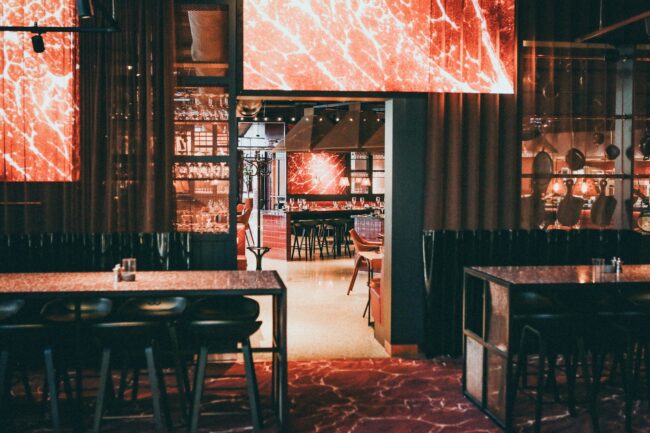
An empty restaurant dining room set for service. Source: Unsplash (Nick Karvounis). License: Unsplash License.
Quick Answer: Orlando-based Darden Restaurants reported fiscal 2027 first-quarter sales of $3.20 billion, up 5.1%, with blended same-restaurant sales up 3.1%. LongHorn Steakhouse led with a 6.2% comparable gain while Olive Garden rose 1.1%. Adjusted diluted EPS from continuing operations rose 4.1% to $2.05, and Darden reaffirmed full-year EPS guidance of $11.10 to $11.35.
Darden Restaurants, the Orlando-headquartered owner of Olive Garden, LongHorn Steakhouse, Yard House, Ruth’s Chris Steak House and The Capital Grille, opened its 2027 fiscal year with steady but uneven growth. The company’s first-quarter results, released on September 24, 2026, and covering the 13 weeks ended August 30, 2026, showed a steakhouse chain still running well ahead of the casual-dining industry, a flagship Italian brand working to rebuild weekday lunch traffic, and a portfolio that continues to add restaurants at a pace of roughly one a week while closing out its Bahama Breeze concept.
As of November 20, 2026, the first quarter is Darden’s most recent reported period. The company has scheduled its fiscal second-quarter report, which will cover the Thanksgiving and early holiday season, for December 18, 2026, according to a company notice.
What did Darden report for fiscal 2027’s first quarter?
Total sales from continuing operations reached $3,200.3 million, up 5.1% from $3,044.7 million in the same quarter a year earlier. Darden attributed the increase to 53 net new restaurants and blended same-restaurant sales growth. On a fiscal-calendar basis, blended same-restaurant sales rose 3.1%; on a comparable-calendar basis, which lines up the same weeks in both years, the gain was 3.2%. The two measures differ because fiscal 2026 was a 53-week year, so this year’s first quarter (June 1 to August 30, 2026) is compared against a fiscal-calendar period of May 26 to August 24, 2025, and a comparable-calendar period of June 2 to August 31, 2025.
Reported diluted earnings per share from continuing operations were $2.05, down from $2.19 a year earlier. The decline reflects a one-time gain in the prior-year quarter rather than weaker operations. Darden’s adjusted figure for the year-ago period excluded a $0.26 per-share gain on the sale of Olive Garden’s Canadian restaurants, along with $0.02 of Chuy’s transaction and integration costs and $0.02 tied to closed restaurants. On that adjusted basis, prior-year EPS was $1.97, so this year’s $2.05 represents a 4.1% increase. Darden made no adjustments to its fiscal 2027 first-quarter results.
How did results compare with Wall Street expectations?
According to a 24/7 Wall St. earnings recap, analysts had expected EPS of about $2.05 on revenue of roughly $3.21 billion. Darden essentially matched on earnings and came in fractionally below on revenue, a gap of about 0.2%. Darden shares fell roughly 6% on the morning of the report, according to the same recap, suggesting investors had hoped for more from Olive Garden, which accounts for more than 40% of company sales.
What happened to profits below the sales line?
Operating income was $319.3 million, compared with $339.2 million a year earlier, when results included a $42.0 million net gain on disposals tied largely to the Olive Garden Canada sale. Net interest expense rose to $50.3 million from $45.4 million. Earnings from continuing operations were $234.3 million, or 7.3% of sales, versus $257.9 million. Chief Financial Officer Raj Vennam said on the earnings call that restaurant-level margin was 18.8%, flat with the prior year, as food and beverage costs rose 30 basis points as a share of sales while labor costs fell 30 basis points. The effective tax rate for the quarter was 12.9%.
| Metric (continuing operations) | Q1 FY2027 | Q1 FY2026 |
|---|---|---|
| Total sales | $3,200.3M | $3,044.7M |
| Blended same-restaurant sales (fiscal calendar) | +3.1% | n/a |
| Operating income | $319.3M | $339.2M |
| Earnings from continuing operations | $234.3M | $257.9M |
| Reported diluted EPS | $2.05 | $2.19 |
| Adjusted diluted EPS | $2.05 | $1.97 |
| Average diluted shares | 114.4M | 117.6M |
| Operating cash flow | $279.0M | $342.5M |
| Capital spending | $175.3M | $174.1M |
How did Olive Garden, LongHorn, Fine Dining and Other Business perform?
Darden reports four segments. The table below shows each one’s same-restaurant sales, segment sales and segment profit for the quarter. Segment margins are calculated from the dollar figures in the release.
| Segment | SRS (fiscal / comparable) | Sales Q1 FY27 (FY26) | Segment profit Q1 FY27 (FY26) | Margin |
|---|---|---|---|---|
| Olive Garden | +1.1% / +1.0% | $1,329.8M ($1,301.1M) | $270.8M ($267.6M) | 20.4% |
| LongHorn Steakhouse | +6.2% / +6.8% | $860.9M ($776.4M) | $154.6M ($134.9M) | 18.0% |
| Fine Dining | +1.6% / +1.0% | $304.2M ($286.5M) | $39.6M ($38.7M) | 13.0% |
| Other Business | +3.8% / +4.5% | $705.4M ($680.7M) | $111.5M ($109.3M) | 15.8% |
Why did Olive Garden grow only about 1%?
Olive Garden’s segment sales rose 2.2% to $1.33 billion, helped by 20 more restaurants than a year earlier, but comparable sales gained only about 1%. On the earnings call, management said guest counts were pressured by an estimated 150 to 200 basis points from the World Cup and from lettuce-related concerns during the quarter. Olive Garden’s newer lighter-portion entrées, offered at lower prices, created about a 50 basis-point headwind to average check and required roughly 30 basis points of margin investment, Vennam said. CEO Rick Cardenas described the smaller-portion menu as a long-term play. Segment margin was 20.4%, down 20 basis points.
The bigger strategic issue is weekday lunch. Vennam said lunch makes up about 20% of Olive Garden’s traffic and remains down hundreds of basis points relative to pre-pandemic levels. Cardenas called weekday lunch a meaningful opportunity. Darden said it planned to market Olive Garden’s unlimited soup, salad and breadsticks offer in the second quarter, after postponing that campaign, and to test a new weekday lunch platform with more variety, according to FSR Magazine’s account of the call.
What is driving LongHorn Steakhouse?
LongHorn was the standout. Comparable-calendar same-restaurant sales rose 6.8%, the brand’s 22nd straight quarter of positive comparable sales, and management said LongHorn’s same-restaurant sales are up 17% over three years. Total segment sales climbed 10.9% to $860.9 million, aided by 29 net new restaurants. Segment profit grew 14.6% to $154.6 million, and the margin expanded 60 basis points to 18.0%. Vennam expects beef costs to rise at a low-single-digit rate in fiscal 2027, in line with the company’s initial estimate.
How are Fine Dining and the Other Business brands doing?
The Fine Dining segment, made up of Ruth’s Chris Steak House, The Capital Grille and Eddie V’s, grew sales 6.2% to $304.2 million, mostly from new units, as same-restaurant sales rose 1.6% on a fiscal-calendar basis. Management said fine-dining traffic remains below pre-pandemic levels, although the decline is slowing, and business spending remains slightly down from a year earlier while private dining is growing.
Other Business, which includes Yard House, Cheddar’s Scratch Kitchen, Chuy’s, Seasons 52, Bahama Breeze and The Capital Burger, grew sales 3.6% to $705.4 million. Yard House posted roughly 10% same-restaurant sales growth, which management estimated included about 180 basis points of lift from the World Cup. FSR reported that Yard House passed $1 billion in trailing 52-week sales, making it Darden’s third brand at that level, with an average unit volume of $10.5 million. Segment margin slipped 30 basis points to 15.8%, which Vennam tied in part to the wind-down of Bahama Breeze.
How many restaurants does Darden operate, and where is it growing?
Darden ended the quarter with 2,218 restaurants in continuing operations, up from 2,165 a year earlier. LongHorn added the most units, while Bahama Breeze shrank from 28 locations to 10. Darden said all remaining Bahama Breeze restaurants are expected to be closed or converted to other brands by the fourth quarter of fiscal 2027. Five of them are slated to become Yard House locations; Yard House plans 13 openings this fiscal year, and half of the remaining openings will use a smaller prototype, according to FSR.
| Brand | Aug. 30, 2026 | Aug. 24, 2025 | Change |
|---|---|---|---|
| Olive Garden | 953 | 933 | +20 |
| LongHorn Steakhouse | 624 | 595 | +29 |
| Cheddar’s Scratch Kitchen | 187 | 182 | +5 |
| Chuy’s | 112 | 108 | +4 |
| Yard House | 95 | 89 | +6 |
| Ruth’s Chris Steak House | 83 | 82 | +1 |
| The Capital Grille | 75 | 73 | +2 |
| Seasons 52 | 44 | 43 | +1 |
| Eddie V’s | 32 | 29 | +3 |
| Bahama Breeze | 10 | 28 | -18 |
| The Capital Burger | 3 | 3 | 0 |
| Total | 2,218 | 2,165 | +53 |
What is Darden’s fiscal 2027 outlook?
Darden reaffirmed every element of the full-year outlook it first issued on June 25, 2026, alongside its fiscal 2026 results. Fiscal 2026 sales totaled $13.21 billion, up 9.4%, with blended same-restaurant sales up 4.5% and adjusted diluted EPS from continuing operations of $10.64. Against those figures, the fiscal 2027 targets imply sales growth of roughly 3% to 4% and adjusted EPS growth of roughly 4% to 7%, a slower pace partly because fiscal 2027 has one fewer week than the 53-week fiscal 2026.
| Fiscal 2027 outlook item | Guidance (reaffirmed Sept. 24, 2026) |
|---|---|
| Total sales | $13.60 billion to $13.75 billion |
| Same-restaurant sales growth | 2.5% to 3.5% |
| New restaurant openings | 75 to 80 |
| Total capital spending | About $875 million |
| Total inflation | About 3.0% |
| Effective tax rate | About 13.5% |
| Diluted EPS, continuing operations | $11.10 to $11.35 |
| Weighted average diluted shares | About 114 million |
What are management’s assumptions on pricing and costs?
Vennam said menu pricing averaged 3.7% in the first quarter and should run in the mid-3% range in the second quarter before moderating to the low-to-mid 2% range by the fourth quarter. He expects commodity inflation of about 3% for the year, at 2.5% to 3% in the second quarter and closer to 3% in the back half.
On the consumer, Cardenas said Darden is not seeing a pullback, and Vennam said sales trends improved through the quarter, with August the strongest month and September stronger still. Management cited industry casual-dining same-restaurant sales of 2.4% with guest counts down 0.2% for the period, meaning Darden’s blended 3.1% to 3.2% gain outpaced the broader category.
How is Darden returning cash to shareholders?
Darden repurchased about 1.1 million shares for $222.3 million during the quarter, leaving $1.3 billion under the $1.5 billion authorization approved in June 2026. It paid $184.2 million in dividends and declared a quarterly dividend of $1.62 per share, payable November 2, 2026, to shareholders of record October 9. That rate, raised 8.0% in June, equals $6.48 on an annualized basis. The buybacks have reduced average diluted shares to 114.4 million from 117.6 million a year earlier, adding to per-share growth.
Why does Darden matter to Florida’s economy?
Darden’s principal executive offices and restaurant support center are at 1000 Darden Center Drive in Orlando, a leased facility, according to its fiscal 2026 annual report. At the end of fiscal 2026 the company employed 209,931 team members, including 198,111 hourly workers, and operated 2,202 company-owned restaurants across all 50 states and Washington, D.C., plus 167 franchised or third-party operated locations, for 2,373 restaurants in total. The 10-K does not break down restaurants by state, so a Florida-specific restaurant count is not publicly reported in that filing.
The company’s roots in the state run deep. The first Red Lobster opened in Lakeland in 1968, and the first Olive Garden opened in Orlando in 1982. General Mills, which bought Red Lobster in 1970, established the restaurant operation’s headquarters in Orlando, and Darden became an independent, New York Stock Exchange-listed company in 1995. Darden sold Red Lobster in 2014 and has since grown by acquisition, buying Ruth’s Chris Steak House in 2023 and Chuy’s in 2024.
For Central Florida, the quarterly numbers matter beyond the stock price. Darden’s planned 75 to 80 new restaurants and roughly $875 million of capital spending in fiscal 2027 are directed from Orlando, and its annual report identifies severe weather, including hurricanes, as a risk to restaurant performance for a company whose headquarters sits in a hurricane-exposed state.
Frequently Asked Questions
What were Darden’s fiscal 2027 first-quarter sales?
Total sales from continuing operations were $3.20 billion for the quarter ended August 30, 2026, up 5.1% from $3.04 billion a year earlier.
How much did Olive Garden same-restaurant sales grow?
Olive Garden’s same-restaurant sales rose 1.1% on a fiscal-calendar basis and 1.0% on a comparable-calendar basis. Management cited World Cup and lettuce-related pressures on guest counts.
Did Darden change its fiscal 2027 guidance?
No. Darden reaffirmed all aspects of its outlook, including sales of $13.60 billion to $13.75 billion, same-restaurant sales growth of 2.5% to 3.5%, 75 to 80 new restaurants and diluted EPS of $11.10 to $11.35.
Is Bahama Breeze closing?
Yes. Darden had 10 Bahama Breeze restaurants at quarter end, down from 28 a year earlier, and expects all remaining locations to be closed or converted to other brands by the fourth quarter of fiscal 2027.
Sources and Further Reading
- Darden Restaurants Reports Fiscal 2027 First Quarter Results, Declares Quarterly Dividend and Reaffirms Fiscal 2027 Outlook – Darden Restaurants (PR Newswire)
- Darden Restaurants Q1 Fiscal 2027 Earnings Call Transcript – Darden Restaurants Investor Relations
- Darden Restaurants Reports Fiscal 2026 Fourth Quarter and Full Year Results and Provides Fiscal 2027 Outlook – Darden Restaurants
- Darden Restaurants, Inc. Form 10-K for Fiscal Year Ended May 31, 2026 – U.S. Securities and Exchange Commission
- Darden’s Sales Rise as Olive Garden Targets Lunch Comeback – FSR Magazine
- Darden Restaurants Q1 2027 Earnings Recap – 24/7 Wall St.
- Darden Restaurants – Wikipedia
About Brian French
Led by a commitment to tech-intelligent curation, Brian French tracks and analyzes breaking business news with Fl Business Newswire. Brian brings an extensive financial background to his analysis, having graduated from the University of South Florida in Finance and serving as a Vice President and Portfolio Manager for Merrill Lynch Private Investors and the Trust Department in St. Petersburg, FL, as well as a Vice President and Trust Investment Officer for SunTrust Bank in Sarasota, FL. His writing blends macroeconomic trends, capital market analysis, corporate strategy, and modern digital insights for a sophisticated look at Florida's business market.