By Brian French
Forget “Silicon Beach.” What’s happening in Miami right now is something entirely its own.
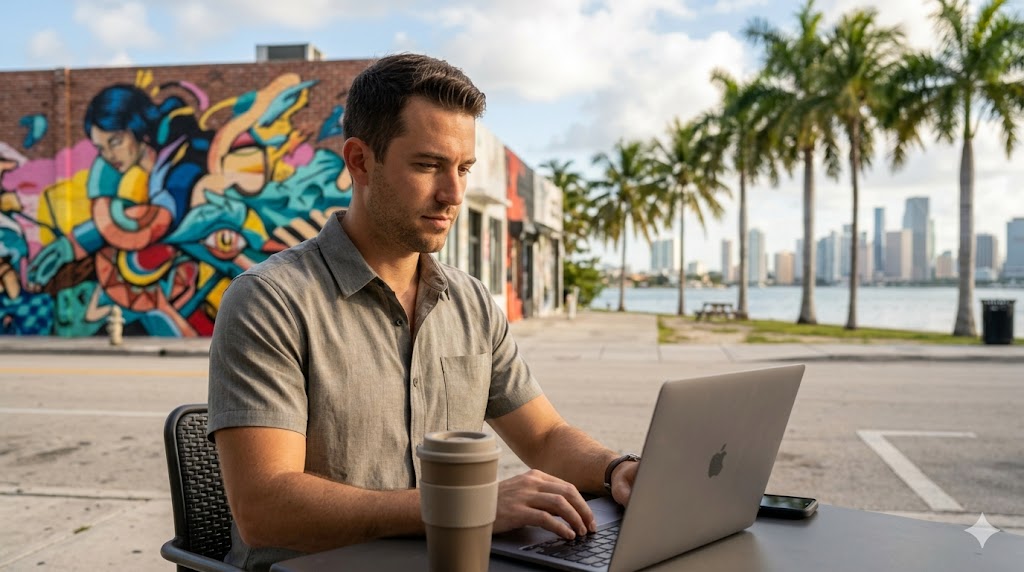
Picture this: It’s 7 a.m. You paddle-board across Biscayne Bay, laptop bag strapped to your back, dolphins occasionally photobombing your commute. By 9 a.m. you’re in a glass-walled loft in Wynwood — street murals visible from your standing desk — pitching to a VC who just flew in from São Paulo. By noon, you’re closing a deal over Cuban coffee at a sidewalk café while your San Francisco ex-colleague is still arguing with his landlord about a $4,500 studio apartment the size of a walk-in closet.
This is not a fantasy. This is Tuesday in Miami in 2026.
The Silicon Valley exodus has been a slow drumbeat for years — a migration story told in tax filings, Zillow searches, and hushed conversations at Bay Area going-away parties. But what started as a trickle of restless founders and contrarian VCs has become something nobody can ignore anymore. Miami isn’t just receiving the overflow from Silicon Valley. It is actively, deliberately, and rather brilliantly building something the tech world has never quite seen before — and the people who figured that out early are already ahead.
The Moment the Narrative Changed
Every city’s tech origin story has a specific, identifiable moment when the hype became real. For Austin, it was Tesla. For Miami, most people point to a tweet.
In December 2020, a venture capitalist posted to Twitter asking if Miami should become a tech hub. The city’s mayor, Francis Suarez, replied with two words that ricocheted across the entire industry: “How can I help?”
That response — from a sitting mayor, to a random tweet, at midnight — sent a signal that no press release, tax incentive, or economic development brochure could have communicated. Miami was open. Not open in the passive, bureaucratic sense of cities that tolerate business. Open in the way a founder is open: hungry, responsive, and genuinely excited about what comes next.
Five years later, that tweet doesn’t look like a lucky PR moment. It looks like a founding document.
The Big Names Didn’t Just Visit. They Stayed. Then They Recruited.
What separates Miami’s tech moment from the dozen other “next Silicon Valley” narratives that have fizzled over the decades is this: the heavy hitters didn’t just buy vacation homes. They bought into the city — and then they started dragging their entire professional networks behind them.
Ken Griffin relocated Citadel — one of the most powerful hedge funds on the planet — and almost immediately began co-chairing a campaign, alongside real estate titan Stephen Ross, to recruit more firms to join him. Their initiative, “Ambition Accelerated,” isn’t a vague civic boosterism project. It’s a structured, funded, concierge-level program that helps CEOs navigate the mechanics of relocation and rebuild their operations in South Florida. Griffin and Ross are essentially venture capitalists for the city itself, investing time and capital into making it easier for the next wave to land.
Peter Thiel and Jeff Bezos made Miami personal bases. Larry Page, co-founder of Google, purchased $173 million in Miami real estate in December 2025, the same month he restructured his California LLCs — quietly but unmistakably signaling where he now calls home. His Google co-founder Sergey Brin followed suit. When the two people most responsible for the modern internet decide to leave Silicon Valley, that is not a lifestyle preference. That is a verdict.
Then, in February 2026, came the move that former Miami Mayor Suarez called a “watershed moment” and a “tipping point”: Palantir — the $300-billion AI company — announced it was relocating its headquarters to Aventura, Florida, just north of Miami. The company had already left Silicon Valley once, citing a clash with Bay Area values, departing for Denver in 2020. This time, the move was toward something specific, not just away from something uncomfortable. Miami won on the merits.
Apple expanded with a new Miami campus. Amazon signed the largest office lease ever recorded in Wynwood — 50,300 square feet in the new Wynwood Plaza development, a one-million-square-foot mixed-use project that itself signals how seriously developers are betting on the neighborhood. ServiceNow committed to a West Palm Beach office. When these companies’ real estate teams start writing Miami addresses on leases, their competitors take notice. Their employees start asking questions. The gravitational pull begins.
The Tax Argument, Told Plainly
Here is the paragraph most Silicon Valley professionals mentally skim over but emotionally absorb immediately.
California’s top marginal income tax rate is 13.3% — the highest of any state in the nation. Florida’s state income tax rate is 0%. Not “lower than California.” Zero. There is no state income tax in Florida, for individuals or for investment income. Florida also has no state estate tax, and its corporate tax rate of 5.5% compares favorably to California’s 8.84%.
One founder who relocated his AI startup from Palo Alto to Wynwood showed a journalist a spreadsheet that was, in the reporter’s words, “frankly sobering.” In San Francisco, the top marginal rate meant that for every dollar of income above a threshold, he kept 86.7 cents at the state level. In Miami, he kept the dollar.
For senior engineers earning $300,000 to $500,000 annually — a common range in Big Tech — the annual savings on state income tax alone ranges from roughly $25,000 to $45,000. That is a new car, a first home down payment contribution, or a meaningful early-stage investment, every single year, just from the geography of where you file your taxes.
For founders with liquidity events — company acquisitions, IPOs, secondary sales — the numbers become generational. A $20 million exit triggers over $2.6 million in California state taxes. In Florida, that bill is zero. This is not a technicality for accountants. It is a life-altering calculation that every founder eventually does on a napkin, usually sometime around their Series A.
And it just accelerated. California’s proposed 5% wealth tax, which could hit billionaires retroactively, sent a wave of the state’s wealthiest tech executives quietly restructuring LLCs, buying Florida real estate, and establishing new domiciles — all before the January 1, 2026 cutoff date. Even California’s own governor called the proposal “really damaging to the state.” When a state’s leadership is publicly begging its wealthiest residents not to leave, the exit sign is flashing.
“Silicon Beach” Is a Label. What Miami Is Building Is a Gateway.
The nickname “Silicon Beach” has been floated for years, and it’s easy to dismiss as marketing. The smarter framing — the one that actually explains why Miami’s tech rise is structurally different from every previous challenger city — is this:
Miami is not trying to replicate Silicon Valley. It is building the bridge between Silicon Valley and the rest of the world.
No other city in North America sits at the intersection Miami occupies. It is the undisputed gateway to Latin America — a continent of 650 million people with exploding middle classes, surging smartphone adoption, and an enormous appetite for fintech, healthtech, edtech, and infrastructure technology. Companies in São Paulo, Bogotá, Buenos Aires, and Mexico City have long needed a credible U.S. headquarters that understands their markets, shares their time zones (or close to it), speaks their languages, and looks culturally familiar to their leadership.
That city is Miami. It always has been. What’s different now is that it also has the capital infrastructure to match. In the first half of 2025 alone, Miami-area startups raised $2 billion in venture capital across 161 deals — putting the region on pace for its best funding year since the post-pandemic peak. Miami now ranks 7th nationally for both VC deal value and deal count. Fintech led the charge with $691 million in funding in just six months. Climate tech startups raised $391 million — bucking the national cooling trend. AI-focused companies drew $830 million in the first half of 2025, nearly matching all of 2024’s AI investment combined.
Major global investors are already here: a16z, SoftBank, Founders Fund, Techstars all operate in the Miami market. The ecosystem has reached critical mass — the threshold where capital attracts talent, talent attracts deals, and deals attract more capital. That flywheel, once spinning, is very difficult to stop.
The Neighborhood-by-Neighborhood Reality
One of the things that surprises tech migrants from the Bay Area is how geographically textured Miami’s tech scene actually is. This isn’t a single campus campus or one dominant neighborhood. Miami has developed distinct districts with distinct personalities — which means, depending on what you’re building and who you are, there’s a specific part of the city that fits.
Wynwood is where the creative energy lives. Murals cover every surface. Amazon just planted its flag here in a development that blurs the line between tech campus and art installation. It’s where web3 events happen, where early-stage founders find each other over espresso, and where the cultural collision between art, tech, and entrepreneurship feels most alive. The chief product officer of World — Sam Altman’s identity and financial network — chose Wynwood for the company’s East Coast flagship precisely because, as he put it: “You’ve got culture, internationalism, and tech all in one place.” World’s Orb biometric devices now sit alongside the neighborhood’s specialty coffee shops and street art like very futuristic, very Miami neighbors.
Brickell is where things move fast. The financial district has transformed from a neighborhood of bank towers and law firms into what one founder described as “Miami’s execution-focused startup zone.” VC offices share floors with AI labs and fintech teams. Private founder dinners and demo nights happen in rooftop clubs. Latin America-focused startups use Brickell as their U.S. headquarters precisely because the neighborhood’s existing network of family offices, hedge funds, and newly relocated institutional investors means the people who write checks are literally in the same building — or at least the same elevator.
There’s also a practical time zone advantage that doesn’t get nearly enough credit. San Francisco sits nine hours behind European markets. Miami sits six. That three-hour difference is the gap between a productive morning call with London and a bleary-eyed midnight scramble. For companies building global products, it is operationally significant every single day.
The Talent Pipeline: Where Things Stand Honestly
Here is where intellectual honesty requires a beat of nuance. Miami’s talent ecosystem, while growing rapidly, is still catching up to its capital base.
Finding a senior engineer who has scaled a platform from ten million to a hundred million users — the kind of deep, specialized experience that Silicon Valley has in abundance — remains harder in Miami than in the Bay Area. The local universities, while improving, haven’t yet produced the density of engineering talent that MIT, Stanford, and UC Berkeley feed into Boston and San Francisco. Building a full technical leadership team in Miami often still requires either relocation packages or flexibility on remote work.
That said, the gap is closing — and it’s closing from both directions. The relocation wave is bringing experienced operators and senior engineers to the city at an accelerating rate. And Miami’s geographic advantage has opened a nearshore talent pipeline that Silicon Valley companies simply don’t have: Brazil, Colombia, and Argentina have produced world-class engineering talent at compensation levels that make Bay Area hiring costs look theatrical. Founders building in Brickell are quietly assembling cross-border teams that combine Miami’s strategic and capital advantages with Latin American engineering depth — and building software faster, and cheaper, than their counterparts in Palo Alto.
The Vanderbilt University graduate campus coming to nearby West Palm Beach by 2029, focused specifically on finance, technology, engineering, and AI, will add a new institutional talent pipeline to the region. Combined with University of Miami and Florida International University’s scaling STEM programs, the engineering talent story in South Florida will look meaningfully different in five years than it does today.
What Nobody Tells You About the Daily Reality
Here’s the part that doesn’t make it into the economic reports.
San Francisco is a city where the daily texture of life — the commutes, the homeless encampments, the impossibility of finding parking, the ambient paranoia about crime, the restaurants that charge $28 for a bowl of noodles — has become a significant, ongoing tax on mental health and quality of life that is separate from, and perhaps more damaging than, the literal tax rate.
Miami is not a perfect city. Housing costs have risen sharply with the migration wave. Traffic on I-95 is a genuine test of character. The summer humidity arrives in May with all the subtlety of a hot wet blanket wrapped around your head. The hurricane season, while manageable with preparation, is a real consideration that Bay Area transplants occasionally underestimate.
But the daily upside is also real and considerable. The beach is not a weekend destination — it is a Tuesday morning reality. The food scene is legitimately world-class in a way that took most transplants by surprise. The international energy — the Spanish, Portuguese, Creole, and dozens of other languages that float through any Miami coffee shop — creates a cultural richness that feels genuinely different from the monoculture of the Bay Area tech bubble. Art Basel, the world’s most prestigious contemporary art fair, descends on the city every December and transforms it into a global gathering of creative and financial power that has no equivalent in San Jose or Palo Alto.
And there’s a feeling — hard to quantify but impossible to ignore — that Miami is a city in the middle of becoming something. The Valley feels like it’s defending what it has. Miami feels like it’s chasing what it can be. For anyone who got into tech because they wanted to build things and shape the future, that distinction matters more than any spreadsheet.
The Bottom Line
The question used to be whether Miami was a real tech hub or an expensive mirage. That debate is over. Palantir settled it. Amazon settled it. The $2 billion in first-half 2025 venture capital settled it. Larry Page buying $173 million in Miami real estate on his way out of California settled it.
The new question is sharper: Is Miami the right move for you, specifically?
If you’re a senior engineer who loves the Bay Area’s density of specialized technical talent and doesn’t mind the cost of living — stay. Silicon Valley still has things no other city has, and honesty about that is more useful than hype in either direction.
But if you’re a founder who wants to build a company with global ambitions, keep more of what you earn, live somewhere that energizes rather than exhausts you, and be in the room with the capital that is actively relocating to your city — Miami is not just an option anymore. It is, for a growing and increasingly impressive number of the people building the next generation of important companies, the obvious choice.
The dolphins on your Tuesday morning paddle-board commute are optional. The financial and strategic logic is not.
Building in Miami or considering the move? Drop your experience in the comments — or reach out directly. The community here is more connected, and more welcoming, than most people expect.