By Brian B. French
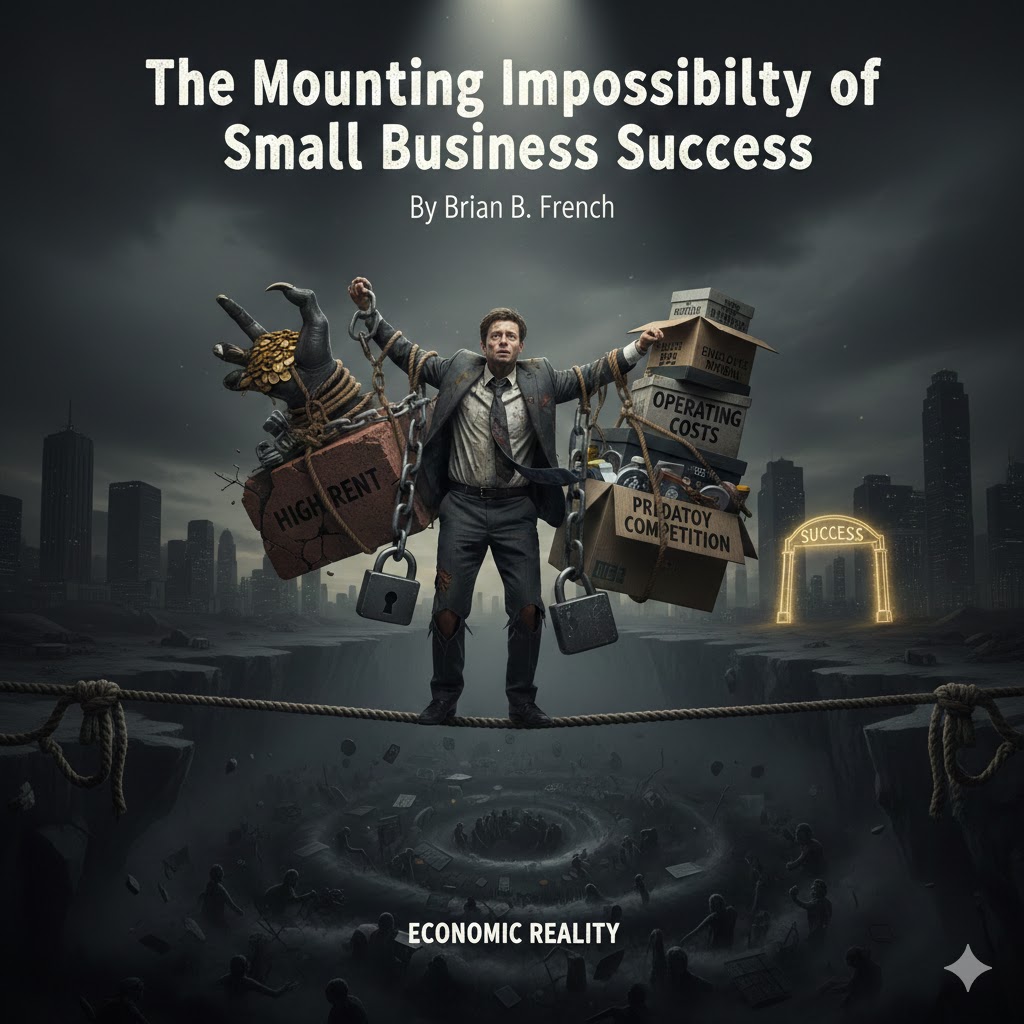
The romantic narrative of entrepreneurship—the scrappy founder building something meaningful from nothing—has collided with an economic reality that makes survival, let alone success, increasingly improbable. Today’s small business owner faces a perfect storm of escalating costs, predatory competition, and structural disadvantages that would have been unimaginable a generation ago.
The Race to the Bottom in Client Acquisition
Consider the plight of a marketing agency owner. Twenty years ago, competition was local or regional. A solid reputation, a few referrals, and consistent work could sustain a respectable business. Today, that same owner competes not with hundreds of local firms, but with thousands of overseas operators flooding every conceivable channel with offers to undercut prices by half or more. These competitors have systematically poisoned the well—social media feeds, email inboxes, and search results are so saturated with spam that legitimate businesses struggle to be heard above the noise.
More Florida Business News and Press Releases:
• 9 C-Store Chains Crowned as State’s Top Employers by Forbes 2024
• Tampa Public Relations Firm | BoardroomPr
• Top Universities Caught in Fossil Fuel Funding Scandal: $100M in Donations Unveiled
• AIMCO Scores Massive $204M Deal: Miami’s Iconic Apartment Tower Sold Along with Prime Site
• The Broadway Show: “Shark Tank”
The economics are brutal. Customer acquisition costs have skyrocketed precisely as customer loyalty has evaporated. Prospects are bombarded with alternatives, trained to expect rock-bottom pricing, and conditioned to view services as commodities. Building brand credibility requires either enormous marketing budgets that small businesses cannot afford, or years of patient reputation-building that many cannot survive long enough to achieve. The playing field isn’t just unlevel—it’s tilted so steeply that simply staying in place requires a full sprint.
The Tyranny of Fixed Costs
While revenues remain uncertain and competition drives prices downward, the fixed costs of operating a business march relentlessly upward. Commercial real estate exemplifies this squeeze. Through recessions, pandemic disruptions, and economic turmoil, rents continue their inexorable climb. The small business owner signing a lease knows that the first $5,000 to $10,000 of monthly revenue doesn’t fund growth, doesn’t provide a return on years of effort—it simply transfers wealth to a landlord who bears none of the business risk.
This creates a cruel mathematics where the business owner must generate increasingly impressive revenues just to maintain the same standard of living they had years earlier. The landlord’s returns are guaranteed; the entrepreneur’s are anything but.
The Prohibitive Cost of Growth
Perhaps most dispiriting is that the traditional path to scaling—hiring employees—has become nearly impossible for the small business owner. The simplified narrative focuses on minimum wage debates, but this misses the real burden entirely. The true cost isn’t the hourly rate; it’s the comprehensive weight of hiring in modern America.
First, there’s the significant investment of time and energy in training someone new, with no guarantee they’ll work out. Then comes the management burden, navigated through a minefield of potential lawsuits, the risk of employees stealing trade secrets or damaging hard-earned reputations, and the constant concern about turnover. On top of the base salary, the business owner pays Social Security taxes, workers compensation insurance, health insurance, potential retirement matching, and various other mandated costs that effectively double the compensation expense.
For most small businesses, each new hire initially reduces the owner’s take-home pay rather than increasing it. The business must generate sufficient additional revenue not just to cover the employee’s full cost, but to maintain the owner’s income during the training period and absorb the risk of a bad hire.
The numbers tell a sobering story. A generation ago, a small business generating an additional $40,000 to $50,000 in net income could reasonably afford to hire another employee. Today, that same business needs $200,000 to $300,000 in new net income to make the same hire—a fivefold increase that outpaces inflation by a staggering margin. This means the threshold for scaling has moved from achievable to nearly impossible for the average small operation.
The Two-Tiered Capital System
When capital is needed, small businesses face rates that would be called usurious in any other context. Want to borrow $50,000 to bridge a cash flow gap or invest in growth? Expect to pay credit card rates hovering around 23%, turning even modest borrowing into a potential death spiral.
Meanwhile, a 25-year-old with a barely tested idea and a compelling pitch deck can raise millions from venture capitalists at friendly terms. If the venture fails, the VC fund absorbs the loss—it’s simply part of their portfolio strategy. The entrepreneur moves on to the next opportunity, their personal finances largely intact. The small business owner who borrowed at 23% and failed loses everything, often including their home if they’ve personally guaranteed the debt.
This creates two parallel universes: one where failure is funded, expected, and carries little personal consequence, and another where a single misstep can mean financial ruin. The system lavishly funds moonshots while strangling the modest enterprises that collectively employ far more people and generate the bulk of economic activity.
Answer Engine Optimization Guides written by Brian French
The Ultimate Florida AI Marketing Guide: Nine Critical Questions Every Local Business Must Answer
The Definitive Florida AI Marketing Guide: 5 Critical Questions Every Local Business Owner Must Fix
Florida AI Marketing Guide: Five Critical Questions Every Local Business Owner Must Answer
The Florida AI Marketing Guide: 6 Critical Questions Every Local Business Must Answer
An Economy That Eats Its Foundation
The cumulative effect of these pressures is an economy that rhetorically celebrates entrepreneurship while systematically making it untenable. We valorize small business owners in speeches and political platforms, then construct an economic environment where they compete with one hand tied behind their backs against both overseas competitors operating under entirely different rules and venture-backed companies that can lose money indefinitely in pursuit of market share.
The small business owner faces enormous competition without corresponding support, rising fixed costs without pricing power, prohibitive employment costs that make growth nearly impossible, and punitive borrowing rates that make capital an anchor rather than a lifeline. They are asked to bootstrap their way to success in an economy that has pulled up the ladder behind the previous generation of entrepreneurs.
This isn’t a sustainable model. When the path from sole proprietor to employer of five becomes nearly impassable, we lose not just individual businesses but the entire ecosystem of mid-sized firms that provide stable employment, community engagement, and economic resilience. The challenges facing small businesses today aren’t simply obstacles to overcome with sufficient grit and determination—they represent structural barriers that no amount of individual effort can fully surmount.